
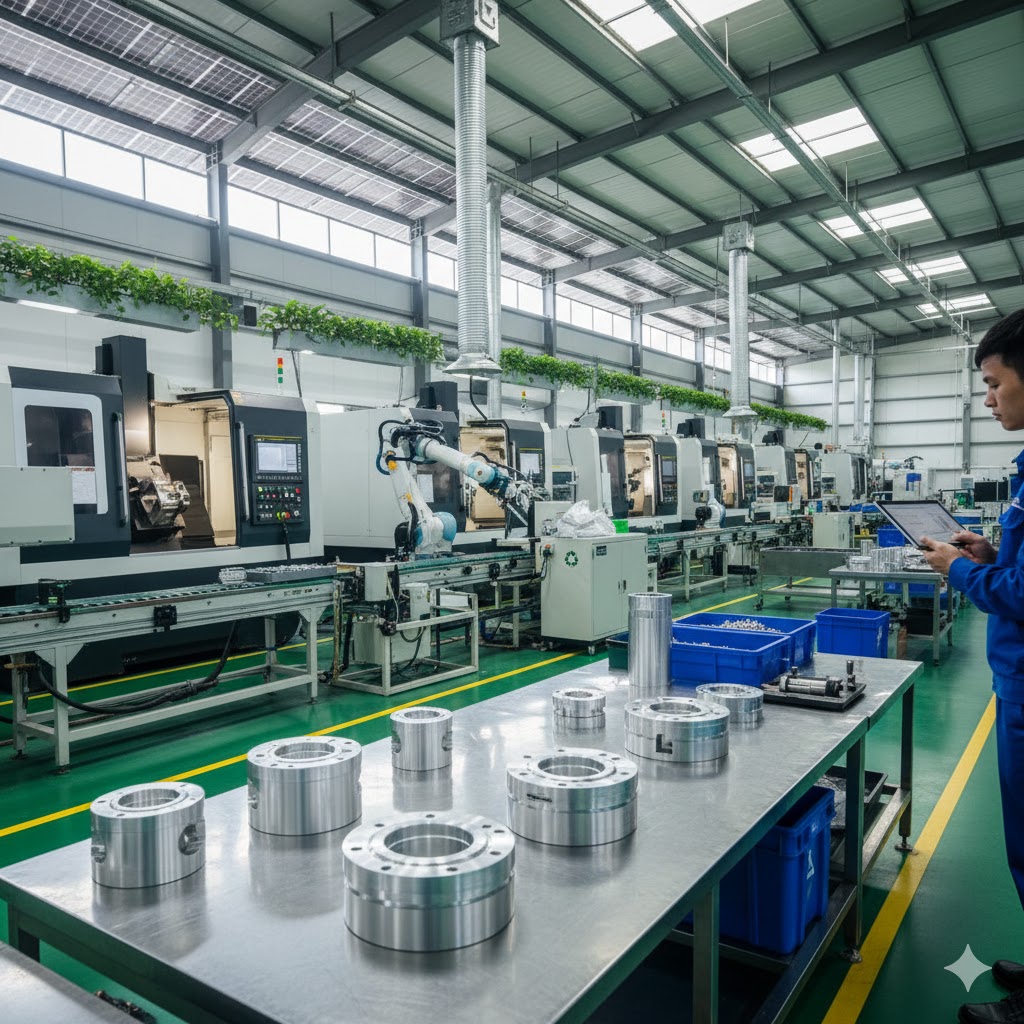
Vietnam Green Manufacturing is becoming a decisive factor for global buyers seeking responsible and future-ready supply chains. As ESG regulations tighten across North America, Europe, and Asia, Vietnam Green Manufacturing plays a central role in aligning cost efficiency with environmental and social compliance.
Manufacturing is no longer evaluated solely on price and precision. Instead, sustainability, carbon transparency, and ethical governance increasingly shape procurement decisions. Therefore, understanding how Vietnam Green Manufacturing integrates ESG principles into CNC machining operations is essential for consideration-stage buyers in 2026.
Vietnam Green Manufacturing in the CNC Sector
Vietnam Green Manufacturing within the CNC machining industry reflects a shift toward energy efficiency, emission reduction, and responsible factory management. While Vietnam remains competitive on cost, sustainability is rapidly becoming a strategic differentiator.
Modern CNC facilities in Vietnam are adopting:
Energy-efficient machinery
Optimized production planning
Waste recycling systems
Digital monitoring tools
Environmental management standards
Because global OEMs now require ESG disclosure from their suppliers, machining companies must document environmental performance. Consequently, sustainability reporting becomes part of supplier qualification processes.
ESG Compliance in Vietnam’s Machining Industry
Environmental, Social, and Governance principles are transforming industrial sourcing strategies. In machining operations, ESG compliance extends beyond environmental considerations.
Environmental factors include carbon footprint reduction and responsible material sourcing. Social factors involve worker safety, fair labor practices, and skill development. Governance focuses on ethical management systems and transparent reporting.
For deeper implementation frameworks, buyers can explore ESG in Machining to understand structured compliance models specific to Vietnam’s industrial sector.
Importantly, ESG compliance does not eliminate cost competitiveness. Instead, it enhances long-term operational resilience and protects brand reputation.
Low Carbon Machining as a Competitive Advantage
Low Carbon Machining is a core pillar of Vietnam Green Manufacturing. Reducing carbon emissions during CNC production requires multiple coordinated strategies.
Energy consumption reduction is the primary focus. Modern CNC machines with optimized servo systems consume less electricity. Additionally, factories increasingly invest in renewable energy integration such as rooftop solar systems.
Material optimization also lowers carbon impact. Improved programming reduces scrap rates, while better nesting strategies minimize raw material waste.
Buyers seeking technical insights into production-level carbon reduction can review Low Carbon Machining practices to evaluate supplier readiness.
Furthermore, transparent carbon accounting strengthens supplier credibility during ESG audits.
Green Factory Transformation in Vietnam
The concept of a Green factory extends beyond emission reduction. It represents an integrated approach to sustainable manufacturing.
Green factories typically implement:
ISO 14001 environmental management systems
Energy monitoring dashboards
Water recycling systems
LED lighting and efficient ventilation
Responsible waste disposal processes
In Vietnam, industrial parks increasingly promote green factory certification programs. As a result, suppliers located within certified zones gain additional sustainability credibility.
Investing in green factory infrastructure not only supports compliance but also reduces long-term operational costs through energy efficiency improvements.
Integration with Vietnam Sourcing Strategy
Sustainability cannot be evaluated in isolation. Buyers must integrate ESG evaluation into broader sourcing frameworks.
For a comprehensive view combining cost, quality, and environmental considerations, companies should consult the Vietnam Sourcing Guide. This strategic model evaluates suppliers across multiple dimensions, including sustainability maturity.
Vietnam Green Manufacturing aligns with long-term sourcing stability. Although initial ESG upgrades may require investment, operational savings and reputational benefits create long-term value.
Regulatory and Market Drivers in 2026
Global regulatory pressure continues to increase. The European Union’s Carbon Border Adjustment Mechanism and expanding ESG disclosure requirements in the United States influence supplier selection.
As these policies evolve, Vietnam Green Manufacturing becomes a risk mitigation strategy. Suppliers capable of providing environmental data and carbon reporting reduce compliance uncertainty for international buyers.
Moreover, multinational corporations increasingly require sustainability data in supplier onboarding processes. Therefore, proactive ESG integration enhances competitiveness.
Operational Benefits of Sustainable CNC Machining
Beyond regulatory compliance, Vietnam Green Manufacturing delivers operational advantages.
Energy-efficient systems reduce utility expenses. Process optimization decreases scrap and rework. Structured governance improves internal communication.
Additionally, worker-focused social programs enhance retention and productivity. When workforce stability improves, production consistency strengthens.
Thus, sustainability aligns economic performance with environmental responsibility.
Evaluating ESG Maturity in Vietnamese CNC Suppliers
Consideration-stage buyers should assess ESG maturity systematically.
Key evaluation areas include:
Carbon footprint measurement capability
Energy consumption tracking systems
Waste management protocols
Environmental certifications
Governance transparency
Requesting documentation and conducting structured evaluations allows buyers to compare supplier readiness objectively.
Moreover, visiting facilities or conducting remote sustainability audits provides further validation.
Future Outlook for Vietnam Green Manufacturing
Vietnam’s industrial ecosystem continues to evolve. As foreign direct investment expands, sustainability expectations rise accordingly.
Government initiatives increasingly encourage renewable energy adoption and industrial efficiency improvements. Consequently, Vietnam Green Manufacturing is likely to accelerate in adoption over the coming years.
Technological innovation also supports sustainability. Digital twin systems and AI-driven production optimization reduce resource consumption. These tools enhance both efficiency and ESG reporting accuracy.
Therefore, sustainable machining practices will increasingly become standard rather than exceptional.
Green Factory Vietnam
Green Factory Vietnam represents the next stage of sustainable industrial development within the broader Vietnam Green Manufacturing strategy. A Green Factory Vietnam facility integrates energy-efficient CNC machinery, rooftop solar systems, smart ventilation, water recycling processes, and structured environmental management systems such as ISO 14001. Moreover, these factories implement carbon tracking, waste segregation, and digital energy monitoring to reduce operational footprint while maintaining precision machining performance. For global buyers, partnering with a Green Factory Vietnam supplier strengthens ESG alignment, improves supply chain transparency, and supports long-term regulatory compliance without compromising cost competitiveness.
Strategic Value for Global Buyers
In competitive markets, supply chain resilience and brand reputation matter as much as pricing.
Vietnam Green Manufacturing strengthens supply chain transparency. It reduces regulatory exposure. It supports corporate sustainability goals.
Additionally, aligning with green suppliers enhances customer trust. As consumers and regulators demand environmental accountability, responsible sourcing becomes a strategic necessity.
By integrating ESG compliance into CNC sourcing decisions, buyers future-proof their operations.
Conclusion
Vietnam Green Manufacturing represents a strategic evolution of the CNC machining industry. Through ESG integration, low carbon machining practices, and green factory transformation, Vietnam’s suppliers increasingly align with global sustainability expectations.
While cost competitiveness remains important, sustainability now shapes supplier selection criteria. Buyers evaluating CNC partners in 2026 must consider environmental performance, governance transparency, and operational efficiency alongside price and precision.
When ESG maturity aligns with strong technical capability, Vietnam emerges as a balanced and forward-looking manufacturing destination.