Smart CNC Factory implementation in Vietnam is redefining automated production standards across precision machining sectors. As global buyers move toward digitally integrated manufacturing partners, Smart CNC Factory systems provide measurable improvements in productivity, traceability, and quality control. This case study outlines how CNC automation and robotic machining transformed a traditional machining facility into a fully connected Industry 4.0 production environment.
Vietnam’s manufacturing ecosystem has matured rapidly. While cost competitiveness remains important, international OEMs now prioritize digital capability, repeatability, and operational transparency. Consequently, smart manufacturing models have become a strategic differentiator for export-focused machining companies.
Smart CNC Factory Architecture and Digital Integration
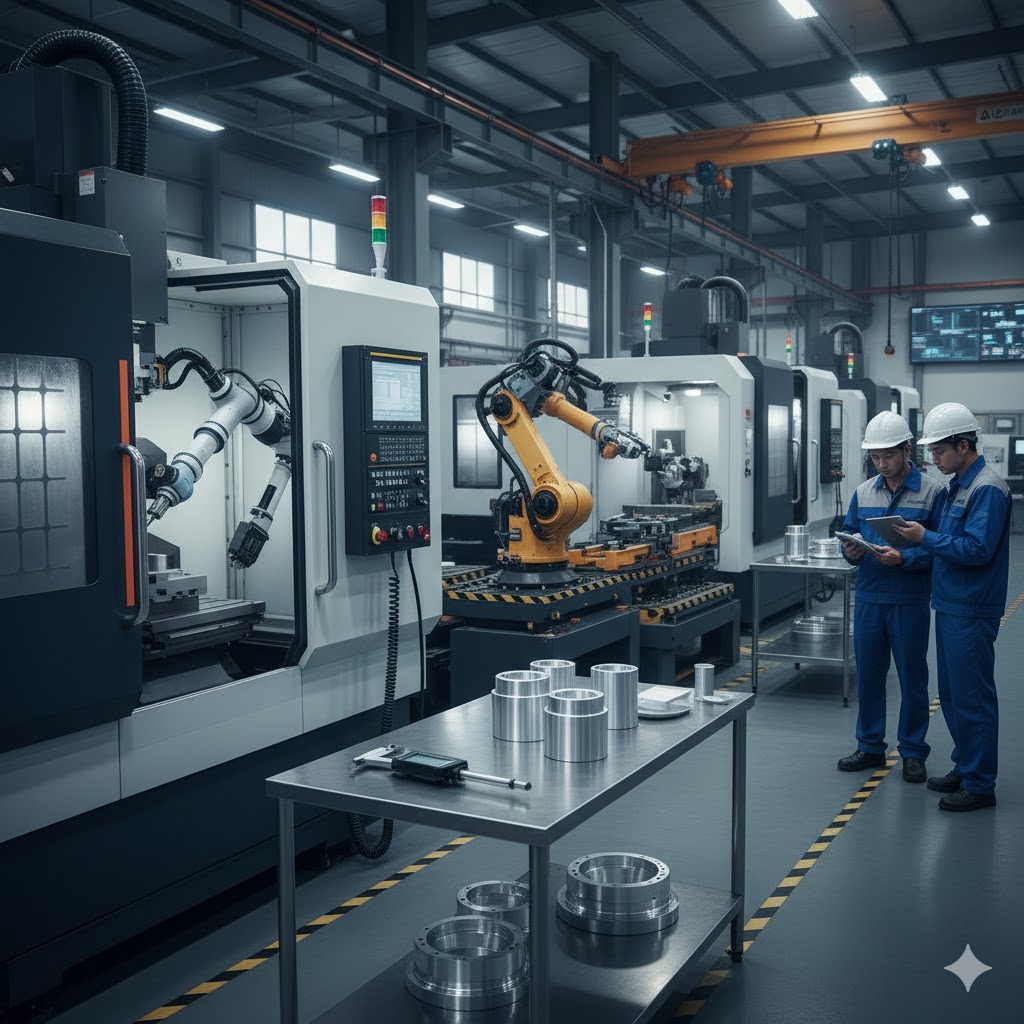
A Smart CNC Factory integrates CNC machining centers, robotic handling systems, real-time monitoring software, and centralized data analytics platforms. Instead of operating as isolated production cells, machines communicate performance data across a unified network.
The facility in this case study implemented:
- Multi-axis CNC machining centers connected to MES systems
- Automated pallet changers for continuous operation
- Real-time tool wear monitoring sensors
- Centralized production dashboards
As a result, production managers gained immediate visibility into spindle utilization, cycle times, and machine health indicators. Therefore, downtime decreased significantly within the first quarter of implementation.
CNC Automation Strategy
CNC automation formed the foundation of the Smart CNC Factory upgrade. The project began with identifying repetitive machining sequences suitable for robotic loading and unloading.
Automation enhancements included:
- Robotic arm integration for part transfer
- Automatic tool presetting systems
- Smart tool life management software
- Predictive maintenance scheduling
By eliminating manual part handling, the factory reduced cycle interruptions. Moreover, automation improved consistency during high-volume production runs.
Robotic Machining for High-Precision Output
Robotic machining does not replace CNC machining accuracy; instead, it enhances process stability. In this facility, robotic systems coordinated seamlessly with machining centers to maintain steady throughput.
Robots performed:
- Raw material loading
- Finished part unloading
- In-process part repositioning
- Conveyor sorting
Because robotic systems operated continuously, production extended beyond traditional working shifts. Consequently, overall equipment effectiveness improved by more than 18 percent within six months.
In addition, robotic machining reduced operator fatigue. Skilled technicians shifted toward programming and quality analysis roles, increasing workforce productivity without increasing headcount.
Quality Control Enhancement Through Automation
Smart CNC Factory implementation also strengthened quality assurance systems. Automated inspection protocols integrated with CNC programs enabled faster verification.
The facility deployed:
- Inline probing systems
- Digital inspection data capture
- Automated deviation alerts
When measurement deviations occurred, the system triggered corrective actions immediately. This proactive approach reduced scrap rates and minimized rework costs.
Furthermore, quality documentation became fully digitized. Clients received real-time production reports and traceability data upon request. This level of transparency reinforced buyer confidence and accelerated approval cycles.
Measurable Production Improvements
Before transitioning to a Smart CNC Factory model, the facility relied heavily on manual oversight. Production planning required manual updates, and inspection data was recorded offline.
After automation implementation:
- Machine utilization increased by 22 percent
- Scrap rate decreased by 15 percent
- Average lead time reduced by 12 percent
- Energy consumption optimized through predictive scheduling
Because real-time analytics supported better decision-making, managers responded quickly to production anomalies.
Workforce Transformation and Skill Development
Smart CNC Factory adoption requires workforce alignment. Rather than eliminating roles, the transition focused on upskilling technicians.
Operators received training in:
- CNC program optimization
- Robotics integration management
- Data analysis interpretation
- Preventive maintenance planning
As digital systems expanded, employee responsibilities evolved toward higher-value engineering tasks. Consequently, operational resilience strengthened while employee engagement improved.
Smart CNC Factory and Industry 4.0 Vietnam
Smart CNC Factory development aligns closely with broader Industry 4.0 Vietnam initiatives. National industrial policies increasingly support digitalization and smart manufacturing investment.
For a comprehensive overview of how digital manufacturing integrates across the country, explore Industry 4.0 Vietnam to understand the strategic transformation shaping modern machining facilities.
CNC Automation as a Competitive Advantage
CNC automation enhances scalability. When demand surges, automated systems maintain consistent output without proportional labor expansion.
Benefits include:
- Improved production predictability
- Lower operational variability
- Enhanced traceability
- Reduced dependency on manual processes
Therefore, Smart CNC Factory environments position Vietnamese manufacturers as reliable long-term partners for global OEM programs.
Robotic Machining and Flexible Production
Robotic machining also supports flexible manufacturing models. Automated cells can switch between component programs with minimal downtime. Tooling presets and digital part libraries streamline transitions between small-batch and large-volume orders.
Because flexibility remains critical in precision industries, robotic integration strengthens responsiveness to shifting client requirements.
Energy Efficiency and Sustainability Impact
Smart CNC Factory systems incorporate energy monitoring software. Real-time tracking of spindle power usage and idle time supports sustainability objectives.
The facility implemented:
- Automated power-down protocols during idle periods
- Load balancing between machines
- Coolant system optimization
These measures reduced energy waste and contributed to improved ESG reporting. Consequently, sustainability performance became a measurable outcome of digital transformation.
Lessons Learned from Implementation
Digital transformation requires phased planning. The facility executed upgrades in three stages:
- Equipment connectivity integration
- Robotic cell deployment
- Full analytics dashboard implementation
By staging the process, operational disruption remained minimal. Early performance improvements funded subsequent investments, creating a self-sustaining modernization cycle.
Additionally, leadership commitment proved essential. Without strategic alignment at the management level, smart manufacturing adoption may stall.
Strategic Outlook for Smart CNC Factory Development
As global competition intensifies, Smart CNC Factory adoption will accelerate across Vietnam. Automation and robotic machining are no longer optional for export-driven manufacturers targeting aerospace, automotive, electronics, and precision engineering markets.
Future developments will likely include:
- AI-driven predictive maintenance expansion
- Cloud-based cross-factory integration
- Enhanced cybersecurity protocols
- Advanced digital twin simulation
Consequently, Vietnamese machining providers will continue elevating production standards in alignment with international expectations.
Conclusion
Smart CNC Factory implementation in Vietnam demonstrates how CNC automation and robotic machining deliver measurable improvements in productivity, quality, and operational transparency. Through structured digital integration, the facility achieved stronger performance metrics while maintaining workforce engagement.
For buyers evaluating machining partners at the decision stage, Smart CNC Factory capabilities provide assurance of long-term reliability, scalability, and precision. Vietnam’s transition toward automated production reinforces its position as a forward-looking manufacturing hub prepared to meet modern industrial demands.
If your organization seeks a digitally integrated machining partner with advanced automation capabilities, now is the time to evaluate Smart CNC Factory solutions in Vietnam and secure a competitive production advantage.