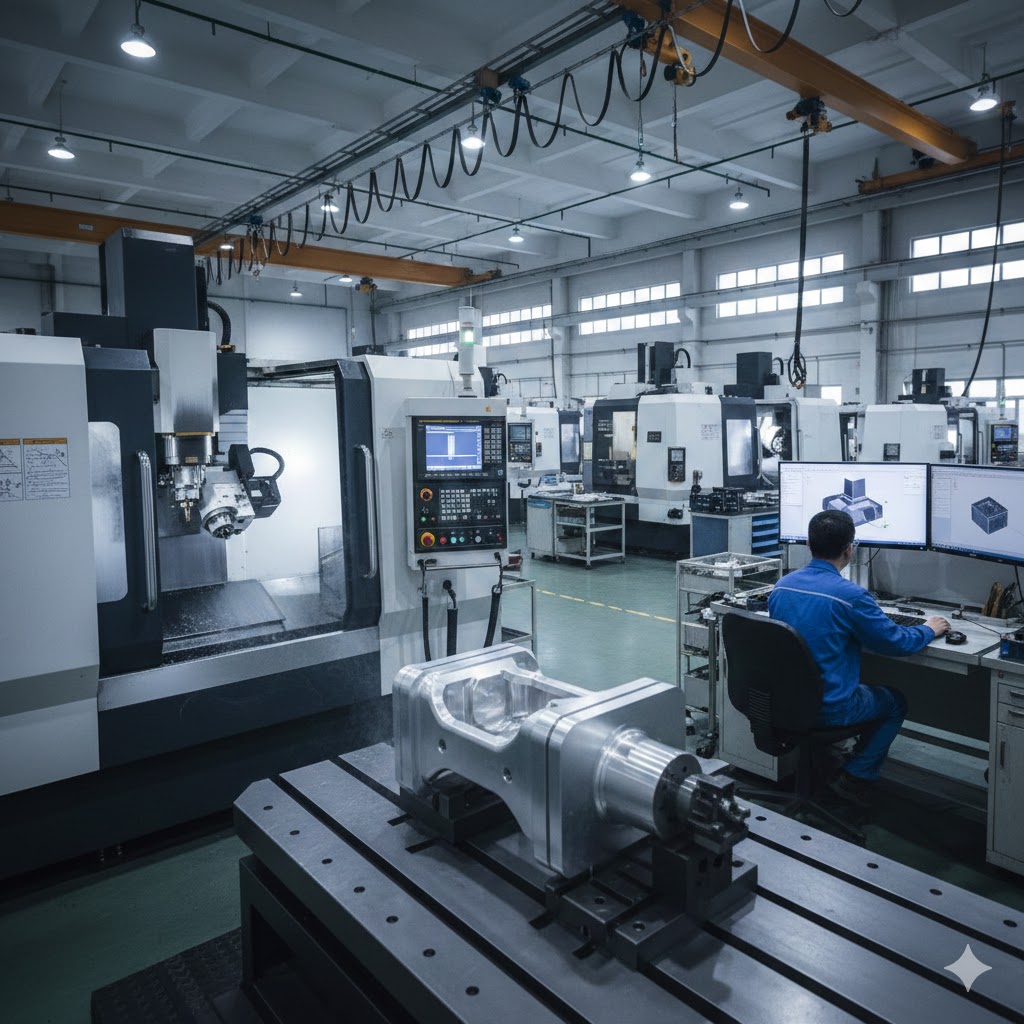
Multi-Axis Machining Vietnam has become a critical capability for global OEMs seeking complex geometries, tight tolerances, and competitive production costs. As manufacturing shifts toward higher precision and shorter lead times, advanced multi-axis systems provide the flexibility and performance required for aerospace, automotive, medical, and industrial applications.
Vietnam’s machining sector has evolved rapidly over the past decade. Today, manufacturers operate advanced 3-axis, 4-axis, and 5-axis CNC platforms alongside Swiss-type and multi-spindle systems. As a result, international buyers can consolidate suppliers while maintaining strict quality control standards. Moreover, integrated engineering support enables faster prototyping and smoother transition into mass production.
Why Multi-Axis Machining Matters for Modern Manufacturing
Traditional 3-axis machining remains suitable for simple components. However, increasingly complex part designs demand simultaneous multi-directional cutting. Multi-axis systems reduce repositioning, improve surface finish consistency, and minimize tolerance stack-up.
With multi-axis platforms, manufacturers can:
Reduce setups and handling time
Improve dimensional accuracy
Machine complex undercuts and contours
Enhance surface finish quality
Increase overall throughput
Because fewer setups are required, geometric accuracy improves significantly. Consequently, scrap rates decrease while process stability increases. In high-value sectors such as aerospace and medical device manufacturing, this precision directly impacts product reliability and compliance.
Multi-Axis Machining Vietnam Capabilities
Multi-Axis Machining Vietnam providers typically offer:
3-axis and 4-axis machining centers for structural parts
Full 5-axis simultaneous machining for complex geometries
CNC turning and mill-turn integration
Multi-spindle production for higher volumes
Engineering support and DFM optimization
These facilities commonly work with aluminum alloys, stainless steel, carbon steel, titanium, brass, and engineering plastics. In addition, many factories maintain ISO-certified quality management systems, ensuring traceability and consistent inspection procedures.
Vietnam’s competitive advantage lies in combining skilled labor with modern imported equipment. Furthermore, manufacturers increasingly integrate CAD/CAM systems and digital workflow tracking. This approach reduces communication errors and supports international collaboration.
Applications of Multi-Axis Machining
Multi-axis machining solutions in Vietnam serve multiple industries.
In aerospace, complex brackets, housings, and structural components require high rigidity and micron-level tolerances. Multi-axis machines allow deep cavity milling and complex contouring without sacrificing dimensional integrity.
In automotive manufacturing, lightweight aluminum components such as engine housings, transmission parts, and EV-related components demand precision and repeatability. Multi-axis systems support both prototyping and serial production.
In the medical sector, surgical instruments and implant components require exceptional surface finish and biocompatible material handling. Simultaneous multi-axis machining ensures precise detailing and fine geometries.
Industrial equipment manufacturers also benefit from custom jigs, molds, fixtures, and mechanical components produced efficiently through advanced CNC processes.
Engineering and Quality Control Integration
High-performance machining requires more than advanced hardware. Engineering expertise plays an equally important role. Vietnamese machining partners increasingly offer DFM consultation at the quotation stage. This practice identifies tolerance risks, optimizes toolpaths, and improves manufacturability before production begins.
Quality assurance typically includes:
CMM dimensional inspection
In-process measurement systems
Surface roughness testing
Material certification verification
Final inspection documentation
Because global clients demand full transparency, reputable suppliers provide detailed inspection reports and maintain structured communication protocols. Consequently, international buyers can manage remote production with confidence.
Cost Efficiency and Lead Time Advantages
Multi-Axis Machining Vietnam solutions deliver measurable cost advantages compared to higher-cost manufacturing regions. Labor competitiveness, stable industrial infrastructure, and expanding logistics networks support efficient export operations.
Shorter lead times result from:
Integrated production planning
Reduced setup cycles
Skilled programming teams
Efficient tool management
Additionally, Vietnam’s strategic location in Southeast Asia facilitates shipping to North America, Europe, and other Asian markets. This logistical advantage strengthens supply chain resilience.
Technology Advancements in Multi-Spindle and Swiss Systems
Beyond standard multi-axis machining centers, advanced production environments integrate high-speed multi-spindle and Swiss-type platforms. These systems increase output efficiency for smaller precision components and high-volume applications.
Multi-spindle systems allow simultaneous operations, significantly reducing cycle time. Meanwhile, Swiss-type machines provide exceptional stability for small-diameter parts requiring extreme precision.
By combining these technologies with multi-axis milling, manufacturers can handle a broader range of part complexities while maintaining throughput efficiency.
Project Management for Global OEMs
Professional machining partners in Vietnam understand the importance of structured project management. Clear RFQ analysis, production scheduling, milestone reporting, and quality documentation form the foundation of successful long-term cooperation.
During the consideration stage of procurement, buyers evaluate supplier capability, communication clarity, and engineering strength. Therefore, Multi-Axis Machining Vietnam providers emphasize transparency and responsiveness.
Strong English-language communication and technical documentation further enhance collaboration with US and EU clients.
Scalability from Prototype to Mass Production
One of the most significant advantages of multi-axis capabilities in Vietnam is scalability. Prototypes can transition seamlessly into pilot runs and then into full-scale production without relocating tooling or changing suppliers.
Because advanced machining platforms handle both low-volume precision parts and high-volume production runs, clients maintain continuity throughout the product lifecycle. This consistency reduces requalification risks and preserves dimensional integrity.
Internal Link Resources for Related Services
For a broader overview of precision manufacturing capabilities across different industries, explore CNC Machining Vietnam. This service hub provides detailed insights into machining standards, material capabilities, and quality control systems supporting international OEM production.
When highly complex geometries require simultaneous multi-directional cutting, consider 5 Axis CNC Vietnam. This specialized solution focuses on advanced 5-axis simultaneous machining for aerospace, automotive, and high-performance mechanical applications.
For small-diameter, tight-tolerance parts produced in larger volumes, review Swiss Machining Vietnam. Swiss-type systems offer exceptional stability and precision for intricate components used in medical devices, electronics, and precision assemblies.
If your project involves intricate shapes and demanding surface finishes, explore Complex CNC Vietnam. This service addresses advanced contouring, deep cavity machining, and structural components with tight dimensional requirements.
Why Choose Multi-Axis Machining Vietnam for Your Next Project
Selecting the right manufacturing partner requires balancing cost, precision, communication, and scalability. Multi-Axis Machining Vietnam providers combine modern equipment, experienced engineering teams, and competitive pricing structures.
Furthermore, Vietnam’s expanding industrial ecosystem continues to attract foreign investment and technology upgrades. As a result, machining providers consistently improve automation, quality assurance, and production capacity.
From prototype development to full-scale OEM production, advanced multi-axis capabilities enable:
Higher geometric complexity
Improved dimensional accuracy
Reduced cycle times
Greater manufacturing flexibility
Enhanced cost control
Because global competition continues to intensify, companies must secure reliable manufacturing partners capable of meeting evolving technical demands. Multi-axis machining solutions in Vietnam provide a strategic balance of precision, efficiency, and scalability.
Conclusion
Multi-Axis Machining Vietnam represents a mature and competitive solution for international manufacturers seeking advanced CNC capability. By integrating multi-axis milling, Swiss-type systems, and multi-spindle platforms, Vietnamese suppliers support complex component production across diverse industries.
With strong engineering expertise, structured quality control, and cost-efficient operations, Vietnam stands as a reliable manufacturing destination during the consideration phase of supplier evaluation. For OEMs requiring precision, flexibility, and long-term scalability, advanced multi-axis machining solutions in Vietnam deliver measurable value.