
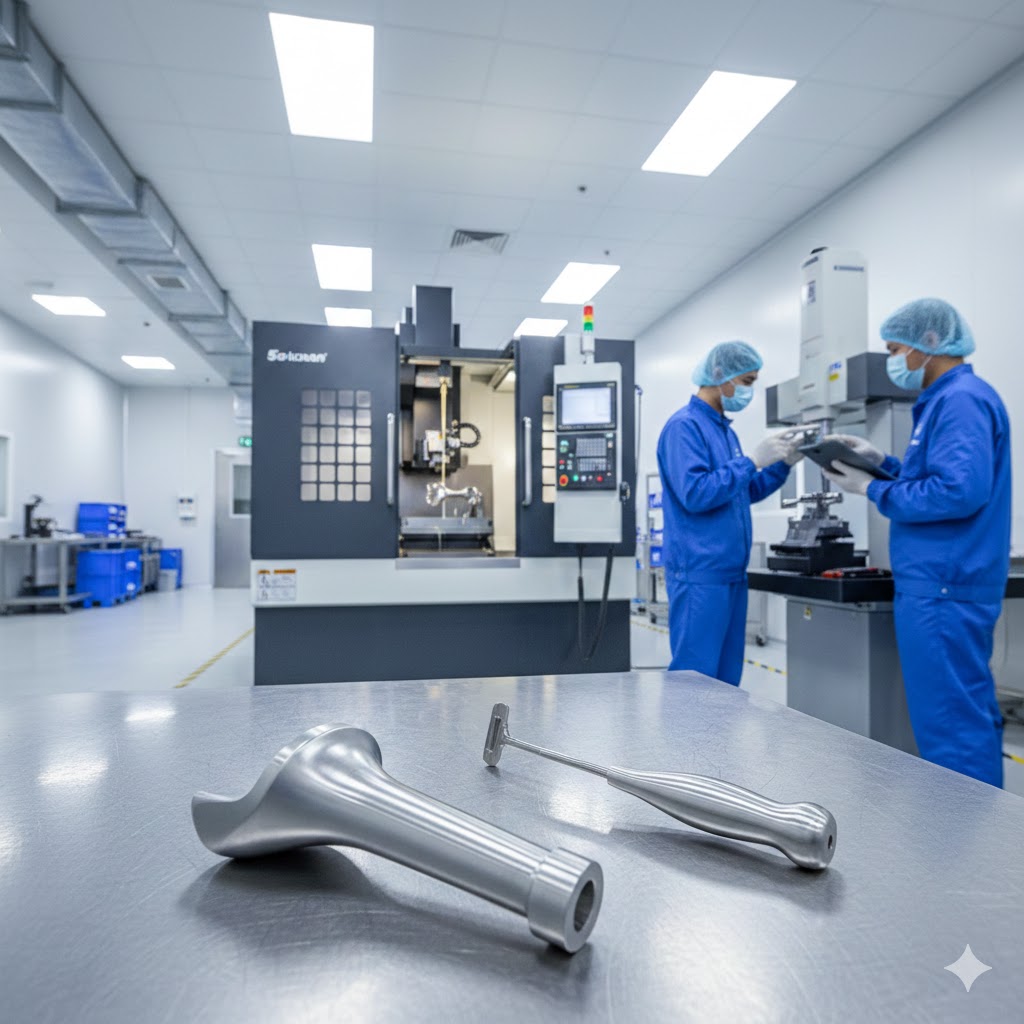
Medical Device Machining in Vietnam has developed into a precision-driven manufacturing service aligned with international healthcare standards. As global medical OEMs seek reliable and compliant production partners, Vietnam offers ISO 13485–aligned quality systems, advanced CNC capability, and export-ready industrial infrastructure.
Today, Medical Device Machining services in Vietnam support implant components, surgical instruments, diagnostic device housings, and high-precision medical assemblies. Positioned within the broader ecosystem of Vietnam Industrial Components, this segment benefits from established CNC expertise while maintaining stricter process control required for regulated medical applications.
This service page outlines machining capability, compliance systems, inspection infrastructure, and export readiness for international medical device manufacturers.
Medical Device Machining Capabilities in Vietnam
Medical Device Machining requires micron-level accuracy, controlled environments, and consistent traceability. Modern CNC facilities in Vietnam operate 3-axis, 4-axis, and 5-axis machining centers designed for high-precision medical components.
Common applications include:
Orthopedic implant supports
Surgical instrument components
Diagnostic device housings
Minimally invasive tool parts
Medical-grade aluminum and stainless assemblies
Because many medical parts involve complex geometries, multi-axis CNC machining reduces repositioning errors and improves repeatability. Additionally, optimized toolpath programming enhances surface finish quality and dimensional stability.
Furthermore, production cells often operate under controlled environmental conditions to minimize contamination risk. This is particularly important for components that require secondary sterilization.
ISO 13485 Compliance in Medical Device Machining
Regulatory compliance is central to Medical Device Machining. Therefore, suppliers serving healthcare OEMs align operations with ISO 13485 standards.
ISO 13485 establishes a comprehensive quality management framework tailored specifically to medical device production. Unlike general industrial certifications, this standard emphasizes risk management, documentation discipline, and validation protocols.
Under ISO 13485 systems, suppliers implement:
Documented process validation
Controlled non-conformance handling
Risk assessment procedures
Traceability tracking for materials and batches
Through these measures, machining providers strengthen reliability and regulatory alignment.
Medical device manufacturers evaluating partners in Vietnam should verify certification scope, audit history, and implementation depth before initiating production programs.
Precision Implant Machining
Orthopedic and implantable components require extreme precision and biocompatibility. Even minor deviations may compromise patient safety.
Implant machining
The capability for Implant machining includes precision milling of titanium alloy components, high-accuracy drilling for bone fixation systems, and surface preparation for implant integration.
Titanium machining requires controlled feed rates and optimized cutting strategies to maintain structural integrity. Furthermore, surface finish plays a critical role in osseointegration performance.
Coordinate Measuring Machines verify dimensional tolerances, while surface roughness testing ensures compliance with implant specifications.
Because implants are highly regulated products, structured inspection and documentation processes are mandatory throughout production.
Surgical Instrument Production
Surgical tools demand both mechanical durability and precise geometry.
Surgical tool CNC
The application of Surgical tool CNC machining supports production of stainless steel forceps, cutting instruments, and minimally invasive surgical components.
Multi-axis machining ensures consistent geometry and sharp edge accuracy. Moreover, finishing processes enhance corrosion resistance and sterilization compatibility.
Inspection protocols confirm dimensional accuracy before packaging. In addition, material verification systems ensure compliance with medical-grade alloy standards.
Since surgical instruments are frequently reused, durability and surface quality significantly impact long-term performance.
Material Expertise and Surface Treatment
Medical Device Machining frequently involves stainless steel, titanium, and medical-grade aluminum alloys. Each material requires tailored machining parameters to achieve optimal results.
Titanium machining demands stable tool engagement and controlled coolant management. Stainless steel requires careful heat control to prevent distortion. Consequently, material expertise plays a decisive role in quality assurance.
Surface treatments such as passivation, anodizing, and specialized coatings enhance corrosion resistance and biological compatibility. These finishing processes are coordinated with certified partners to meet regulatory requirements.
Inspection and Metrology Infrastructure
Reliable medical machining requires advanced inspection capability. Export-oriented facilities invest in:
Coordinate Measuring Machines
Optical measurement systems
Surface roughness testers
Material composition verification tools
Inspection data is digitally archived to support regulatory documentation and audit readiness.
Moreover, periodic calibration programs ensure measurement integrity over time.
Although supplier capability levels vary, top-tier Medical Device Machining providers meet stringent international quality expectations.
Integration Within Vietnam Industrial Components Ecosystem
Medical machining operations are part of the broader Vietnam Industrial Components ecosystem. While quality standards differ between industrial and medical sectors, shared CNC infrastructure enhances capacity flexibility.
This integration allows medical machining providers to leverage engineering expertise developed in other precision sectors while maintaining strict compliance protocols specific to healthcare manufacturing.
Export Infrastructure and Global Supply Chain Alignment
Vietnam’s industrial zones are strategically located near major ports, supporting efficient international shipping. Suppliers experienced in medical export documentation streamline customs procedures and regulatory paperwork.
Furthermore, diversified logistics networks enhance supply chain resilience.
However, international buyers should conduct facility audits to verify cleanroom capability, quality documentation, and capacity alignment before finalizing long-term agreements.
Cost Structure and Strategic Positioning
Medical Device Machining in Vietnam offers competitive cost positioning compared to Western markets. Nevertheless, cost advantage alone does not define supplier selection in healthcare manufacturing.
Technical reliability, compliance integrity, and traceability systems remain primary decision factors.
By integrating Vietnam into diversified sourcing strategies, medical OEMs reduce production risk while maintaining regulatory alignment.
ESG and Sustainability Considerations
Sustainability increasingly influences healthcare procurement decisions. Suppliers invest in energy-efficient machinery, wastewater management systems, and waste reduction programs.
Alignment with environmental standards strengthens eligibility for global medical contracts and enhances long-term competitiveness.
Engineering Collaboration and Development Support
Successful medical programs require close technical collaboration during design and validation phases. Vietnamese machining providers support tolerance analysis, manufacturability review, and prototype development.
Structured communication channels reduce production risk and accelerate time to market.
Over time, continuous improvement initiatives optimize machining efficiency and cost control while preserving compliance integrity.
Conclusion
Medical Device Machining Vietnam represents a growing and strategically positioned segment within the country’s precision manufacturing landscape. Through ISO 13485–aligned systems, advanced implant machining capability, and surgical tool CNC expertise, Vietnam delivers export-ready medical components at competitive cost levels.
Integrated within Vietnam Industrial Components, medical machining providers offer international healthcare OEMs a reliable, compliant, and scalable manufacturing solution for regulated medical device production programs.