Prototype Machining Vietnam services enable OEMs to transform digital designs into functional metal components with speed, precision, and engineering control. In competitive global markets, rapid validation of product concepts is critical. Therefore, companies increasingly rely on rapid prototyping through CNC machining to test geometry, material behavior, and assembly compatibility before scaling to production.
Vietnam has become a strong destination for precision prototyping due to its modern CNC infrastructure, skilled engineering teams, and export-ready manufacturing ecosystem. As a result, Prototype Machining Vietnam providers support fast iteration cycles while maintaining tight tolerance standards required by aerospace, automotive, medical, and industrial sectors.
Why Prototype Machining Vietnam Accelerates Product Development
Product development cycles are shorter than ever. Engineering teams must validate performance, optimize geometry, and prepare for mass production within compressed timelines. Prototype Machining Vietnam solutions address these challenges by delivering accurate metal components directly from CAD models.
Unlike additive methods that may not fully represent material strength, CNC-based rapid prototyping uses production-grade materials. Consequently, prototypes reflect realistic mechanical properties, thermal performance, and dimensional stability.
Key advantages include:
Fast turnaround for functional metal parts
Real material validation
High dimensional accuracy
Surface finish consistency
Scalability toward low volume production
Because prototypes are machined using the same technology that supports mass production, transition to later manufacturing stages becomes smoother and more predictable.
Rapid Prototyping Through Advanced CNC Systems
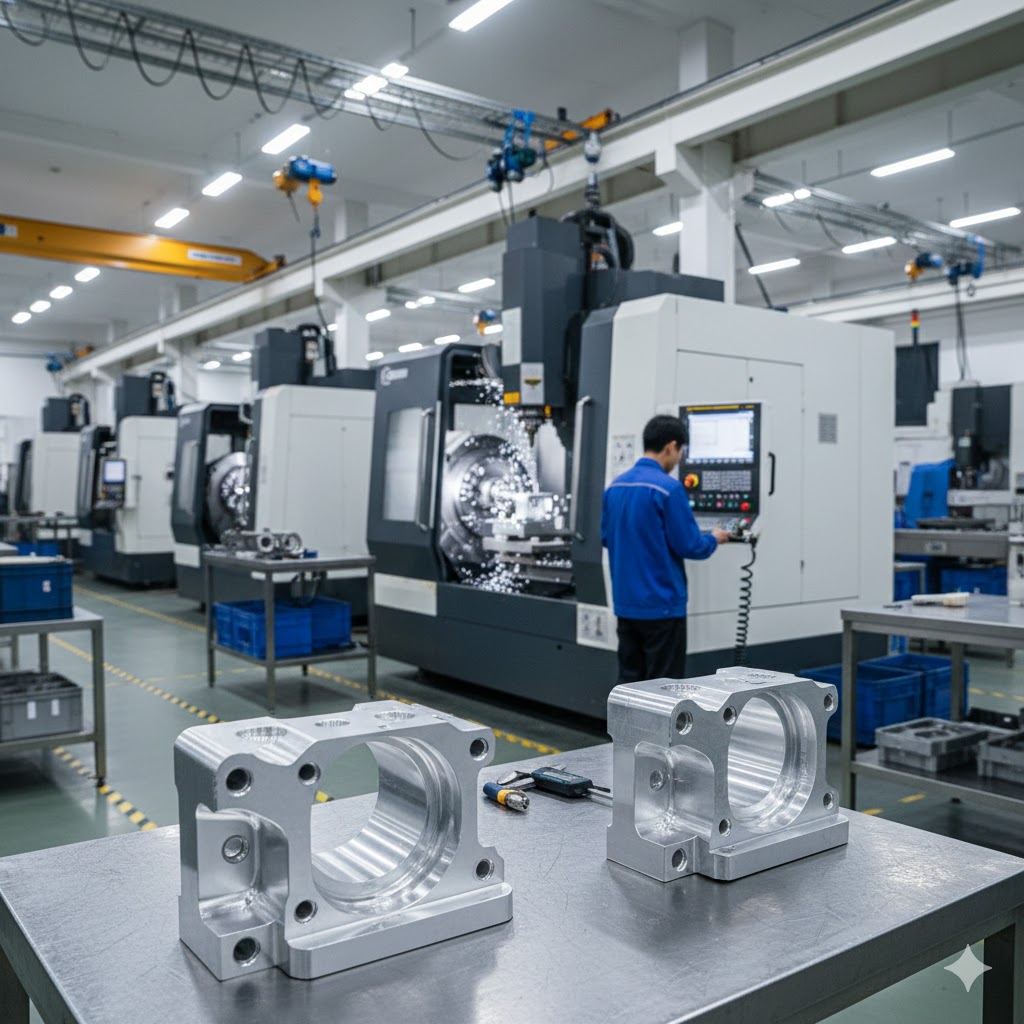
Rapid prototyping in Vietnam relies on advanced multi-axis CNC platforms capable of milling and turning complex geometries. These machines allow engineers to produce intricate features, undercuts, and tight-tolerance surfaces in a single setup.
Rapid prototyping workflows typically include:
CAD file review and DFM consultation
Material selection analysis
Toolpath simulation
Pilot machining
Dimensional inspection and validation
Engineering collaboration begins immediately after RFQ approval. By reviewing manufacturability early, suppliers can reduce unnecessary complexity and optimize part design before cutting material.
Because modern CNC machines operate with high-speed spindles and automated tool changers, cycle times remain efficient even for complex geometries. This capability shortens development timelines without sacrificing quality.
CNC Mockup Validation for Engineering Accuracy
CNC mockup production plays a critical role in product validation. A CNC mockup allows engineers to verify fitment, mechanical alignment, and structural performance before committing to production tooling.
Prototype Machining Vietnam providers often deliver CNC mockups for:
Assembly testing
Functional load validation
Heat and stress analysis
Customer demonstration units
Pre-certification inspection
Since these mockups are produced using precise machining methods, dimensional reliability remains high. Therefore, engineering teams can confidently evaluate real-world performance under simulated operating conditions.
Moreover, feedback from mockup testing can be integrated quickly into design revisions. Because CNC programs are digitally adjustable, geometry updates can be implemented without major tooling changes.
Materials Used in Prototype Machining Vietnam
Material selection influences both performance validation and cost considerations. Prototype Machining Vietnam services commonly support aluminum alloys, stainless steel, carbon steel, titanium, brass, and engineering plastics.
Aluminum is frequently used for early-stage functional validation due to its machinability and favorable strength-to-weight ratio. Stainless steel prototypes allow corrosion resistance testing. Titanium supports aerospace and medical validation where strength and biocompatibility are essential.
By machining prototypes from production-grade materials, manufacturers ensure realistic performance evaluation. This approach reduces the risk of unexpected issues during later production phases.
Quality Assurance and Inspection
Even during early development, dimensional accuracy remains critical. Reputable Prototype Machining Vietnam suppliers implement structured inspection procedures to verify compliance with engineering drawings.
Inspection processes typically include:
Coordinate Measuring Machine validation
Surface roughness testing
Tolerance verification
Material certification documentation
Because prototypes serve as the foundation for future production approval, detailed reporting strengthens client confidence. Additionally, inspection data provides a benchmark for later volume manufacturing.
Continuous monitoring and process calibration maintain machining precision throughout multiple prototype iterations.
Seamless Transition from Prototype to Production
One of the key advantages of Prototype Machining Vietnam lies in scalability. After design validation, the same engineering team and machining platform can transition into low volume or serial production.
This continuity offers several benefits:
Reduced requalification risk
Consistent dimensional control
Preserved process knowledge
Improved cost forecasting
Instead of transferring production to a new supplier, OEMs maintain workflow stability with a single Vietnam Machining Partner. As a result, communication gaps decrease and timelines remain predictable.
Engineering Collaboration and Fast Iteration
Rapid product development depends on responsive communication. Vietnamese machining providers increasingly offer strong English-language engineering support and digital workflow management.
Design for Manufacturability consultation allows geometry refinements before machining begins. Consequently, unnecessary features that increase cost or machining time can be optimized early.
Digital file management systems track revisions and maintain clear documentation. This transparency improves coordination between global design teams and manufacturing engineers.
Because prototype machining projects often involve multiple design iterations, structured collaboration ensures each revision improves performance and manufacturability.
Industry Applications for Rapid Metal Parts
Prototype Machining Vietnam supports numerous industries.
Aerospace companies use rapid metal parts to validate lightweight structural brackets and housings. Automotive manufacturers test engine components, suspension brackets, and EV structures. Medical device developers rely on precise prototypes for surgical tools and implant components. Industrial equipment companies evaluate custom fixtures and mechanical assemblies before full production.
In each case, precision and speed directly impact product launch timelines. Therefore, reliable rapid prototyping capability strengthens competitive positioning.
Related On Demand Machining Solutions
For integrated lifecycle manufacturing beyond prototype development, explore Vietnam Machining Partner solutions. This service hub outlines scalable on demand machining from early design validation through full production programs.
Why Choose Prototype Machining Vietnam for Rapid Metal Parts
Selecting a supplier at the decision stage requires evaluating speed, technical depth, and long-term scalability. Prototype Machining Vietnam providers combine advanced CNC capability, structured inspection systems, and competitive manufacturing costs.
By leveraging modern multi-axis machining centers and experienced engineering teams, Vietnamese suppliers deliver rapid prototyping that aligns with global OEM standards. Furthermore, seamless transition from CNC mockup validation to production ensures continuity and operational efficiency.
For companies seeking fast, reliable, and production-ready prototype solutions, Prototype Machining Vietnam offers a strategic advantage built on precision, responsiveness, and engineering collaboration.