Automotive CNC Vietnam has become a strategic Tier 2 manufacturing solution within global automotive supply chains. As OEMs and Tier 1 suppliers diversify production footprints, Vietnam offers precision CNC machining supported by IATF-aligned quality systems, competitive cost structures, and export-ready industrial infrastructure.
Today, Automotive CNC Vietnam supports drivetrain components, structural assemblies, transmission housings, and engine-related precision parts. Positioned within the broader framework of Transportation Machining Vietnam, automotive machining operations benefit from shared technical infrastructure, skilled engineering resources, and expanding industrial clusters.
This service page outlines CNC capabilities, compliance systems, inspection infrastructure, and supply chain readiness for international automotive programs.
Automotive CNC Vietnam Capabilities and Production Scope
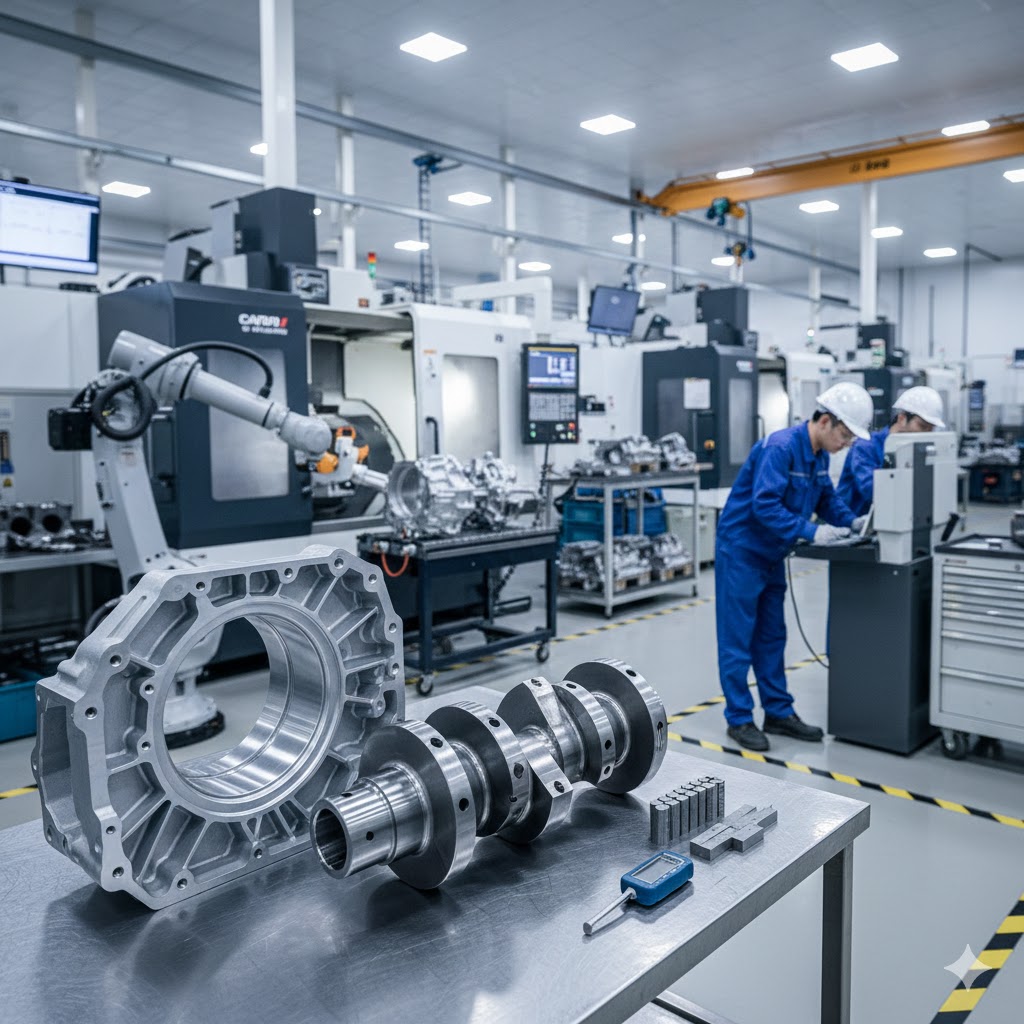
Modern Automotive CNC Vietnam facilities operate advanced 3-axis, 4-axis, and 5-axis machining centers. These systems enable high-repeatability production across aluminum, cast iron, and alloy steel components.
Typical production includes:
Engine mounting brackets
Transmission housings
Cylinder head components
Structural aluminum supports
Precision shafts and flanges
Because automotive manufacturing requires stable output and dimensional consistency, CNC centers integrate automated probing and tool management systems. Moreover, optimized machining strategies reduce cycle variability while maintaining tight tolerances.
In addition, digital performance dashboards monitor spindle load, tool wear, and production throughput. Consequently, manufacturers maintain efficiency across mid-to-high volume programs.
Automotive CNC Vietnam and IATF 16949 Compliance
Quality compliance defines supplier eligibility within automotive programs. Therefore, Automotive CNC Vietnam operations align with structured automotive-specific quality standards.
IATF 16949
IATF 16949 certification establishes a comprehensive quality management framework tailored for automotive production. This system emphasizes risk mitigation, traceability, and continuous improvement.
Under IATF 16949 systems, suppliers implement:
Production Part Approval Process documentation
Statistical Process Control monitoring
Corrective action procedures
Supplier audit programs
Through disciplined implementation, machining providers reduce defect rates and enhance delivery reliability. Furthermore, structured documentation improves audit readiness and global buyer confidence.
When evaluating suppliers, automotive procurement teams should confirm certification scope, audit history, and implementation depth.
Precision Machining for Car Engine Parts
Engine components operate under high stress, temperature, and rotational forces. As a result, machining precision directly impacts reliability and durability.
Car engine parts
The production of Car engine parts includes CNC milling of aluminum engine housings, precision turning of steel crank components, and complex drilling operations for lubrication channels.
Multi-axis CNC platforms reduce repositioning errors and improve geometric repeatability. Meanwhile, Coordinate Measuring Machines verify critical tolerances before shipment.
Surface finish testing also plays a critical role. Smooth internal bore surfaces ensure proper sealing and performance efficiency within engine assemblies.
Because engine systems demand high reliability, strict validation procedures are applied during pre-production and ongoing batch inspection.
Production Scalability in Automotive CNC Vietnam
Unlike aerospace production, which typically involves lower volumes, automotive manufacturing requires scalable and repeatable output. Automotive CNC Vietnam operations are structured to meet this demand.
Factories integrate automated part loading systems and in-line inspection checkpoints. Lean manufacturing principles reduce waste and enhance throughput efficiency.
Moreover, standardized work instructions and controlled setup procedures ensure consistency between production shifts.
Industrial clusters in Vietnam allow Tier 2 suppliers to coordinate with Tier 1 integrators and OEM procurement teams efficiently. As a result, export timelines remain stable and supply chain risk is reduced.
Material Expertise and Process Engineering
Automotive components frequently involve aluminum castings, high-strength steels, and ductile iron materials. Each material requires optimized machining parameters to maintain tolerance accuracy.
Process engineers carefully balance feed rates, spindle speeds, and tooling coatings to improve surface quality while minimizing tool wear.
Furthermore, coolant management systems reduce thermal distortion and maintain dimensional stability.
Continuous process optimization strengthens both cost efficiency and production reliability.
Inspection Infrastructure and Quality Assurance
Reliable automotive machining requires robust inspection capabilities. Leading Automotive CNC Vietnam facilities invest in:
Coordinate Measuring Machines
Optical measurement systems
Hardness testing equipment
Surface roughness analyzers
Inspection data is recorded digitally to support traceability and compliance documentation. Additionally, equipment calibration programs ensure measurement consistency over time.
While supplier capability levels vary, top-tier automotive machining providers meet international OEM expectations for dimensional control and documentation discipline.
Integration with Transportation Machining Vietnam
Automotive CNC Vietnam operates within the larger ecosystem of Transportation Machining Vietnam, which includes aerospace and EV segments.
Shared CNC infrastructure allows capacity balancing and cross-sector expertise. However, automotive production maintains its own quality frameworks aligned specifically with IATF standards.
This integration enhances operational flexibility without compromising compliance discipline.
Cost Structure and Competitive Positioning
Vietnam offers competitive labor rates compared to Western manufacturing markets. However, cost efficiency alone does not determine supplier selection.
The primary advantage lies in the balanced combination of price, quality compliance, and supply chain resilience.
By incorporating Automotive CNC Vietnam into diversified sourcing strategies, OEMs reduce dependency on concentrated geographic regions while maintaining production stability.
Sustainability and ESG Alignment
Environmental compliance increasingly influences automotive procurement decisions. Consequently, machining suppliers invest in energy-efficient equipment, waste reduction programs, and emission monitoring systems.
Alignment with ESG frameworks strengthens long-term competitiveness and supports global customer requirements.
Engineering Collaboration and Program Support
Automotive programs require close collaboration during development and ramp-up phases. Vietnamese suppliers provide manufacturability analysis, tolerance evaluation, and process planning support.
Transparent communication and structured quality reviews reduce risk during production scaling.
As partnerships mature, continuous improvement initiatives enhance cycle efficiency and cost optimization.
Conclusion
Automotive CNC Vietnam represents a strategically positioned Tier 2 supply chain solution within global automotive manufacturing. Through IATF 16949-aligned systems, precision car engine parts machining capability, and scalable CNC infrastructure, Vietnam delivers export-ready components at competitive cost levels.
Integrated within Transportation Machining Vietnam, the country provides OEMs and Tier suppliers with a reliable, quality-focused, and diversified sourcing alternative for modern automotive production programs.