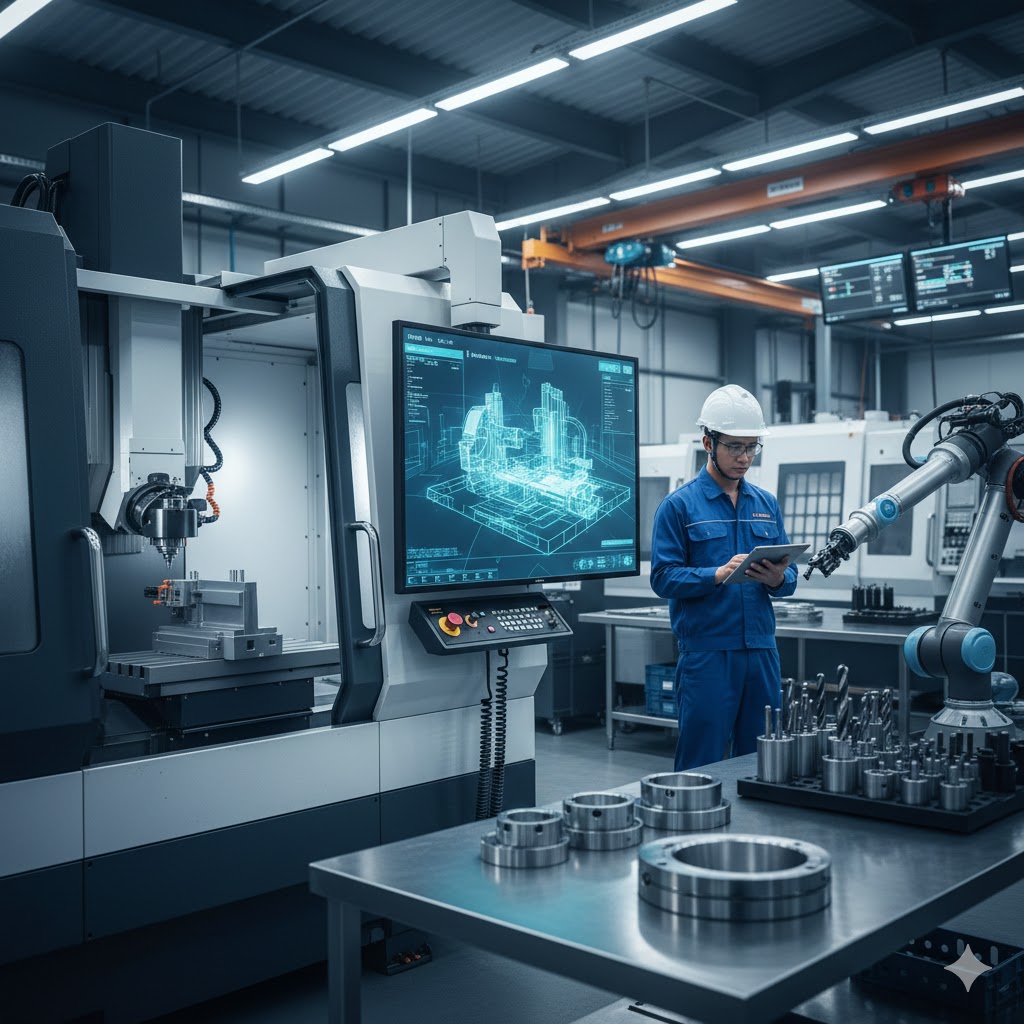
CNC Digital Twin technology is redefining how advanced machining facilities in Vietnam design, simulate, and optimize production processes. As Industry 4.0 Vietnam accelerates across smart factories, CNC Digital Twin systems allow manufacturers to validate toolpaths, predict machining risks, and simulate full virtual production environments before any physical cutting begins. This guide explains how digital twin technology enhances operational reliability, efficiency, and competitiveness in modern Vietnamese manufacturing.
Vietnam’s precision machining sector has moved beyond traditional CNC programming. Instead of relying on repeated physical trials, leading factories now build virtual machine replicas that mirror real-world conditions. Consequently, engineers reduce setup time, minimize scrap, and improve overall process stability.
CNC Digital Twin in Smart Manufacturing
A CNC Digital Twin is a virtual replica of a physical CNC machine, including its kinematics, spindle behavior, tooling parameters, and operational constraints. Unlike basic simulation software, this technology integrates real machine data to ensure accurate predictive modeling.
Within Industry 4.0 Vietnam, digital twin systems connect machining centers, sensors, and production analytics platforms. As a result, factories gain synchronized insight across machining, inspection, and scheduling operations.
Core capabilities include:
- Real-time machine behavior modeling
- Toolpath collision detection
- Thermal distortion prediction
- Tool wear forecasting
- Production cycle validation
Because the virtual model reflects real equipment characteristics, simulation outcomes closely match physical machining performance.
Predictive Machining Through Digital Simulation
Predictive machining allows engineers to anticipate problems before production begins. Rather than discovering errors during cutting operations, manufacturers test strategies in a virtual environment.
Simulation platforms can forecast:
- Axis overtravel risks
- Tool interference scenarios
- Spindle overload conditions
- Surface finish inconsistencies
- Vibration instability
Therefore, engineers optimize feeds, speeds, and tool selection before committing to material. This proactive approach significantly reduces costly rework.
Reduced Trial-and-Error Programming
Traditional machining often involves multiple adjustment cycles. However, virtual machining environments eliminate much of that inefficiency.
By validating toolpaths digitally:
- Setup time decreases
- Programming errors decline
- Scrap material is minimized
- Production ramp-up accelerates
Consequently, manufacturers improve responsiveness while maintaining strict dimensional tolerances.
Virtual Production Workflow Simulation
Virtual production extends beyond individual toolpaths. It models the entire machining workflow, including fixture setups, multi-operation sequences, and changeover processes.
With full workflow simulation, factories can:
- Validate clamping stability
- Optimize cycle sequencing
- Compare alternate machining strategies
- Estimate accurate production costs
Because digital models replicate machine kinematics and process constraints, virtual production results closely mirror actual outcomes. Buyers therefore gain stronger confidence in program feasibility.
CNC Digital Twin and Multi-Axis Machining
Five-axis machining introduces significant complexity. Precise synchronization between rotary and linear axes requires careful validation.
A CNC Digital Twin accurately models machine movement envelopes, axis limits, and dynamic interactions. Engineers detect potential collisions or clearance issues before execution. As a result, machine safety improves while protecting expensive tooling assets.
This capability is particularly valuable for aerospace components, automotive housings, and high-tolerance aluminum structures.
Real-Time Data Integration and Feedback Loops
Modern digital twin systems connect directly to live machine data streams. IoT sensors transmit spindle load, temperature, and vibration metrics to the simulation platform.
Because the virtual model updates continuously, calibration between digital and physical environments remains accurate. This feedback loop enables:
- Adaptive parameter refinement
- Continuous process optimization
- Performance benchmarking
- Predictive maintenance planning
Instead of operating static simulations, manufacturers maintain dynamic digital environments aligned with real-world production.
Cost Efficiency and Operational Impact
The financial benefits of adopting CNC Digital Twin technology are measurable. Vietnamese machining facilities implementing virtual machining report:
- Lower scrap rates
- Reduced setup times
- Improved tooling lifespan
- Faster prototype validation
- Enhanced quoting accuracy
Accurate cycle-time prediction strengthens cost estimation during the bidding phase. Therefore, manufacturers can provide more reliable proposals to international clients.
Additionally, minimizing trial runs reduces material waste and energy consumption. This improvement supports sustainability goals alongside productivity gains.
Workforce Upskilling and Engineering Advancement
Digital twin adoption enhances workforce capabilities rather than replacing technical roles. Engineers shift from reactive troubleshooting toward predictive optimization.
Training focuses on:
- Simulation parameter tuning
- Data analytics interpretation
- Kinematic modeling
- Advanced CAM integration
Because experimentation occurs in a virtual environment, learning cycles accelerate without risking machine damage. As Vietnam expands smart manufacturing initiatives, digital twin proficiency becomes a valuable technical asset.
Cybersecurity and Intellectual Property Protection
Connected simulation platforms require secure infrastructure. Manufacturers must protect machine models, CAD data, and proprietary process parameters.
Effective safeguards include:
- Encrypted communication protocols
- Role-based access control
- Secure cloud storage
- Continuous audit tracking
By implementing strong cybersecurity measures, factories maintain compliance with global client standards.
Implementation Roadmap for Vietnamese Manufacturers
Successful deployment follows a structured approach:
- Create accurate 3D machine models
- Map machine kinematics and constraints
- Integrate CAD CAM systems
- Deploy sensors for calibration
- Train engineering teams
- Establish ongoing performance review cycles
Phased implementation minimizes operational disruption while delivering measurable improvements.
Strategic Relevance for Decision-Makers
At the consideration stage, buyers evaluate long-term reliability and digital readiness. CNC Digital Twin capability signals advanced process control and lower production risk.
Key advantages for international OEMs include:
- Improved program validation before launch
- Transparent process documentation
- Reduced unexpected downtime
- Higher dimensional consistency
Because virtual machining reduces uncertainty, procurement teams can commit with greater confidence.
Alignment with Industry 4.0 Vietnam
Digital twin systems represent a core component of national smart manufacturing strategies.
For a broader view of digital transformation initiatives, explore Industry 4.0 Vietnam to understand how connected machining technologies support competitive supply chain positioning.
Future Outlook of Virtual Machining in Vietnam
As Industry 4.0 adoption expands, digital twin platforms will integrate deeper AI analytics. Adaptive models may automatically adjust machining parameters based on historical production data.
Cloud-based collaboration tools will likely enable cross-factory synchronization. Consequently, manufacturers can compare performance metrics across multiple sites and optimize at scale.
Over time, digital simulation will become standard practice in high-precision sectors rather than a competitive advantage.
Conclusion
CNC Digital Twin technology empowers Vietnamese manufacturers to simulate, validate, and optimize machining processes before physical execution. Through predictive machining and virtual production modeling, factories reduce risk, enhance efficiency, and strengthen quality assurance.
For organizations evaluating advanced machining partners, CNC Digital Twin capability demonstrates digital maturity and operational sophistication. As Vietnam continues its Industry 4.0 transformation, virtual machining environments will remain central to delivering precision, scalability, and long-term competitiveness in global markets.
Companies seeking smarter, data-driven production strategies should consider collaboration with manufacturers that leverage digital twin technology to ensure optimized machining performance and reliable delivery outcomes.