
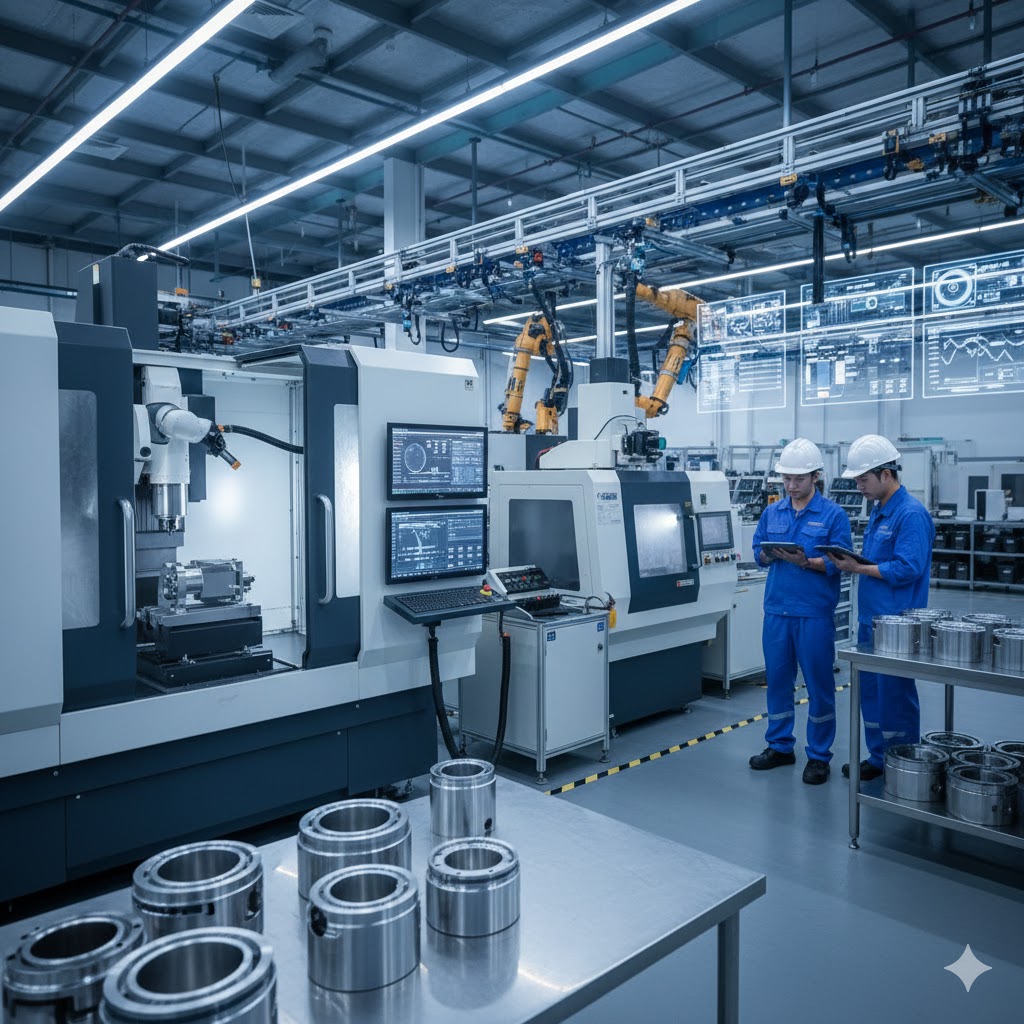
Industry 4.0 Vietnam is reshaping the national manufacturing landscape through smart factories, AI-driven inspection systems, and digitally connected CNC operations. As global buyers demand higher transparency, real-time traceability, and zero-defect quality, Vietnam’s machining sector is accelerating its transition toward fully integrated Industry 4.0 CNC ecosystems. This transformation strengthens competitiveness while supporting long-term supply chain resilience.
Over the past decade, Vietnam has evolved from a cost-driven production hub into a technology-enabled manufacturing center. Today, industrial investors and OEM buyers increasingly evaluate Vietnam not only for pricing advantages but also for its digital readiness. Consequently, Industry 4.0 Vietnam stands at the core of advanced machining strategy for 2026 and beyond.
Industry 4.0 Vietnam and the Rise of Smart Factories
Industry 4.0 Vietnam integrates automation, IoT connectivity, real-time analytics, and intelligent production planning. Smart factories connect machines, operators, and management systems into one synchronized digital environment. Instead of operating in silos, CNC equipment now communicates production data instantly to centralized dashboards.
This shift enables:
- Real-time machine monitoring
- Predictive maintenance alerts
- Digital production scheduling
- Automated quality reporting
- Data-driven cost optimization
As a result, Vietnamese factories improve efficiency while reducing downtime and scrap rates.
Smart CNC Integration in Modern Facilities
Industry 4.0 CNC systems connect multi-axis machining centers to enterprise resource planning platforms. Machine sensors collect spindle load data, vibration patterns, and tool wear indicators. Production managers therefore gain immediate visibility into performance metrics.
Rather than relying on manual reports, decision-makers access live dashboards that display:
- Overall Equipment Effectiveness
- Production cycle times
- Defect ratios
- Energy consumption
Because of this digital integration, manufacturers respond quickly to deviations and maintain consistent output quality.
AI CNC Inspection and Zero-Defect Quality
Artificial intelligence is transforming inspection processes across the machining industry. AI-based systems analyze part geometry using high-resolution cameras and machine learning algorithms. These systems identify micro-defects that traditional visual inspection may overlook.
AI CNC inspection in Vietnam delivers several advantages:
- Faster inspection cycles
- Automated defect classification
- Reduced human error
- Continuous quality learning
Furthermore, integration with CMM systems enhances dimensional verification accuracy. When deviations occur, AI models flag anomalies immediately. This proactive approach minimizes batch rework and protects customer confidence.
In competitive global markets, zero-defect manufacturing is not optional. Instead, it is a prerequisite for aerospace, automotive, electronics, and precision engineering sectors.
Industry 4.0 CNC Automation for Scalable Production
Industry 4.0 CNC automation extends beyond inspection. It incorporates robotic loading systems, automated tool changers, and centralized production control software.
Vietnamese machining facilities increasingly deploy:
- Collaborative robots for part handling
- Automated pallet systems
- Smart tool management software
- Cloud-based performance analytics
By combining these technologies, factories reduce labor dependency while improving throughput consistency. Additionally, automated scheduling ensures optimal machine utilization across multiple production lines.
Consequently, Industry 4.0 Vietnam supports both prototype runs and high-volume production without sacrificing precision.
Digital Twin Technology in CNC Machining
Digital twin technology creates a virtual replica of physical machining processes. Engineers simulate machining parameters, tool paths, and thermal conditions before actual production begins.
CNC digital twin systems in Vietnam enable:
- Collision detection simulation
- Tool wear forecasting
- Thermal distortion prediction
- Process optimization testing
Because simulations occur before material cutting, manufacturers minimize material waste and shorten development cycles. Moreover, customers gain higher confidence in complex component production.
Digital twins also facilitate remote collaboration. International clients can review virtual machining simulations before approving final production programs.
Data-Driven Manufacturing and ESG Alignment
Industry 4.0 Vietnam also supports environmental and governance objectives. Smart monitoring systems track energy consumption, coolant usage, and scrap rates in real time.
With transparent data reporting, factories:
- Reduce energy waste
- Optimize raw material usage
- Improve carbon footprint tracking
- Enhance compliance documentation
Therefore, digital transformation strengthens both operational performance and sustainability commitments.
Workforce Transformation and Technical Upskilling
Smart factory development requires skilled technicians capable of managing automated systems. Vietnam’s technical workforce continues to expand through university partnerships and vocational training programs focused on CNC programming, robotics integration, and industrial data analysis.
Instead of replacing workers, Industry 4.0 CNC systems shift roles toward higher-value tasks such as:
- Process engineering
- Predictive maintenance
- Quality analytics
- Automation programming
As digital adoption accelerates, workforce capability becomes a competitive differentiator.
Strategic Benefits for Global Buyers
For international OEMs and industrial buyers, Industry 4.0 Vietnam offers multiple strategic benefits:
- Increased production transparency
- Shorter lead times through automation
- Enhanced quality assurance with AI systems
- Reduced supply chain risk through digital traceability
- Long-term cost stability via efficiency optimization
Because of these advantages, Vietnam strengthens its position as a reliable machining partner in global supply networks.
Integration with Vietnam Industry Applications
Smart manufacturing technologies extend beyond CNC machining. They integrate with broader industrial ecosystems.
For a comprehensive overview of how digital transformation supports cross-sector growth, explore Vietnam Industry Applications to understand how Industry 4.0 innovation drives energy, heavy equipment, electronics, and precision component sectors.
Smart CNC Factory Development
Smart factory implementation represents a foundational pillar of Industry 4.0 Vietnam. Facilities investing in automation create scalable production models that support long-term expansion.
Learn more about advanced automation systems in Smart CNC Factory solutions that enable fully integrated automated production environments.
AI CNC Inspection for Quality Leadership
Precision manufacturing depends on reliable inspection. Intelligent systems now replace manual review processes.
Discover how AI CNC Inspection technology enhances zero-defect production standards and improves dimensional verification consistency.
CNC Digital Twin for Virtual Machining Optimization
Digital simulation improves design validation and machining performance before physical production begins.
Explore CNC Digital Twin technology to understand how virtual machining reduces risk, saves material, and accelerates time to market.
Industry 4.0 Vietnam 2026 Outlook
Industry 4.0 Vietnam will continue evolving as factories invest in AI analytics, predictive maintenance platforms, and integrated robotics. Meanwhile, government support for digital industrialization encourages further modernization across manufacturing zones.
Global supply chains increasingly favor technology-enabled partners. Consequently, Vietnamese machining providers that adopt Industry 4.0 CNC systems gain stronger competitive positioning.
By 2026, digital connectivity, automated inspection, and data-driven optimization will become baseline expectations rather than differentiators. Early adopters therefore secure long-term strategic advantage.
Conclusion
Industry 4.0 Vietnam is not simply a technological upgrade. It represents a structural transformation of the machining industry. Through AI inspection systems, digital twin simulations, and automated CNC integration, Vietnam strengthens its ability to serve high-precision global markets.
For buyers evaluating advanced machining partners, Vietnam offers a compelling combination of cost efficiency, digital readiness, and scalable automation. Industry 4.0 CNC innovation positions the country as a forward-looking manufacturing hub prepared for the demands of modern industrial supply chains.
If your organization seeks a digitally integrated machining partner aligned with Industry 4.0 standards, now is the time to engage with Vietnam’s smart factory ecosystem and evaluate next-generation CNC capabilities.