Construction Machining in Vietnam supports global OEMs and Tier suppliers seeking reliable production of heavy-duty components. As infrastructure investment expands worldwide, demand for precision-engineered heavy equipment parts continues to rise. Vietnam has emerged as a competitive manufacturing base offering strong CNC capability, industrial scalability, and export-ready logistics.
Today, Construction Machining services in Vietnam deliver complex structural components, load-bearing assemblies, and high-tolerance excavator systems. Integrated within the broader ecosystem of Vietnam Industrial Components, this sector benefits from mature CNC expertise, strong material sourcing networks, and consistent quality management systems.
This service page outlines machining capabilities, material expertise, inspection standards, and supply chain advantages for international construction equipment manufacturers.
Construction Machining Capabilities for Heavy Equipment
Construction Machining requires durability, dimensional accuracy, and resistance to extreme working conditions. Components must perform under heavy loads, vibration, and exposure to harsh environments. Therefore, machining precision and material integrity are critical.
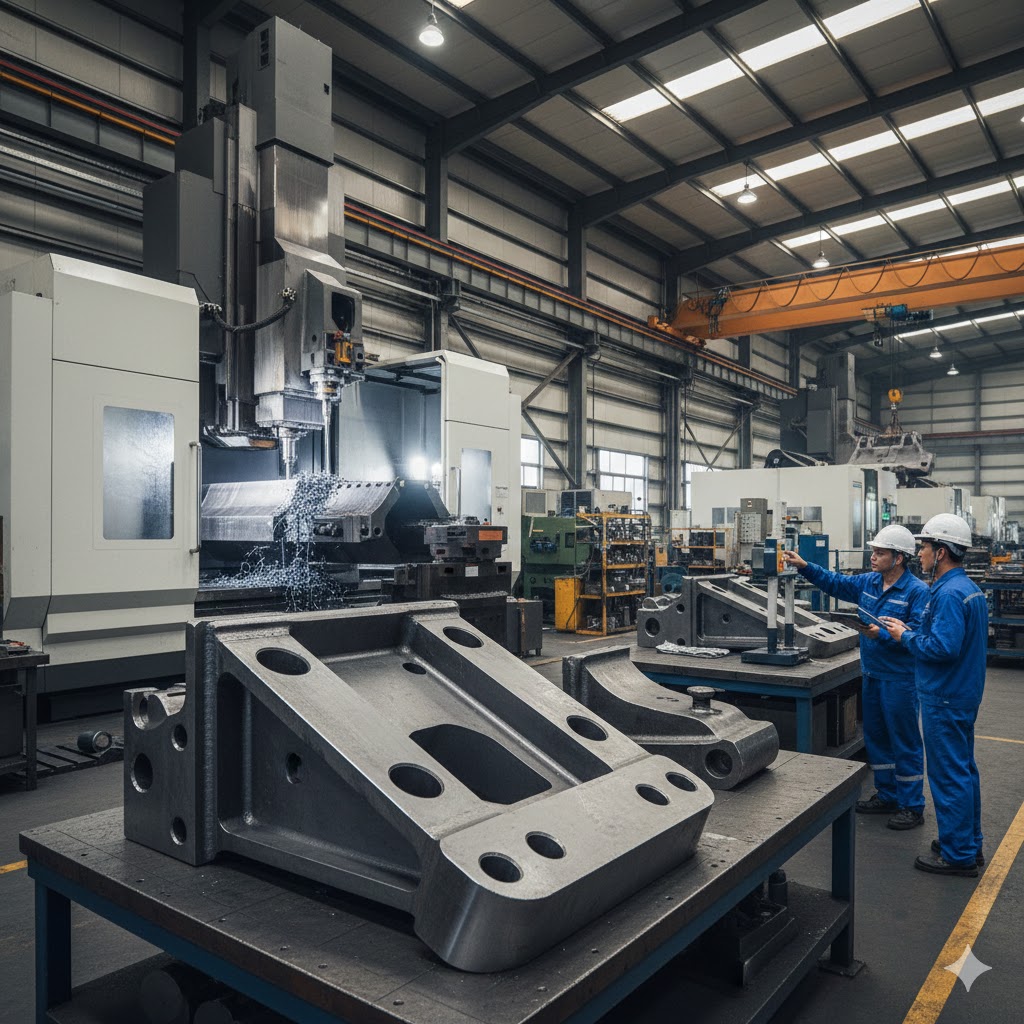
Modern CNC facilities in Vietnam operate large-format 3-axis and 5-axis machining centers capable of handling steel castings, forged components, and high-strength alloy parts. These machines support:
Structural frames
Gear housings
Hydraulic cylinder components
Mounting brackets
Engine support assemblies
Because heavy machinery parts often involve thick materials and complex geometry, optimized cutting parameters ensure dimensional stability and surface quality. Additionally, automated tool monitoring improves repeatability across production batches.
While part sizes vary significantly, advanced fixturing systems allow consistent machining for both medium and large components.
Heavy Equipment Parts Manufacturing
Heavy equipment components must withstand continuous operational stress. Precision tolerances ensure proper alignment of mechanical systems and hydraulic assemblies.
Heavy equipment parts
Production of Heavy equipment parts includes structural steel components, drivetrain housings, transmission supports, and load-bearing brackets for construction machinery.
Material selection plays a decisive role in durability. High-strength carbon steel, alloy steel, and ductile iron are commonly used depending on application requirements. CNC machining ensures critical dimensions meet design tolerances after casting or forging.
Furthermore, machining strategies reduce residual stress and distortion, which enhances long-term structural integrity. Secondary processes such as heat treatment and surface finishing further improve performance under extreme conditions.
Inspection systems validate tolerances before components move to assembly or export.
Excavator CNC Parts Production
Excavators represent one of the most demanding construction equipment categories. Their mechanical systems require precise coordination between hydraulic components, rotating joints, and structural supports.
Excavator CNC parts
Manufacturing of Excavator CNC parts includes swing bearing supports, hydraulic pump housings, bucket linkage components, and engine mount structures.
Because excavator components must maintain dimensional accuracy under vibration and impact, machining consistency is essential. Multi-axis CNC equipment allows machining of complex profiles in fewer setups, reducing alignment error.
Moreover, advanced metrology equipment verifies bore concentricity, parallelism, and surface flatness. These parameters directly affect machine performance and longevity.
Surface treatments such as coating preparation and corrosion-resistant finishing enhance durability for field applications.
Material Expertise and Structural Integrity
Construction Machining frequently involves high-strength steels, wear-resistant alloys, and thick-section castings. Each material requires optimized tooling and feed rate strategies to prevent tool wear and thermal distortion.
Heat-treated materials demand stable cutting conditions to preserve mechanical properties. Consequently, machining centers with rigid structures and vibration control systems deliver improved performance.
In addition, many components require post-machining processes such as stress relieving, coating preparation, or protective finishing. Coordinated production workflows ensure each step aligns with export standards.
By combining robust material handling with precise machining control, Vietnamese manufacturers deliver consistent heavy-duty parts for global markets.
Quality Control in Construction Machining
Quality assurance remains a central requirement for international buyers. Construction equipment OEMs expect dimensional accuracy, documentation transparency, and batch consistency.
Inspection systems typically include:
Coordinate Measuring Machines
Digital bore gauges
Surface roughness testers
Hardness testing equipment
Inspection data is recorded and archived to support traceability. Although heavy machinery components may allow wider tolerances compared to aerospace parts, consistency across production runs remains critical.
Furthermore, structured process control minimizes defect rates and improves delivery reliability.
Integration Within Vietnam Industrial Components Network
Construction Machining operates within the broader network of Vietnam Industrial Components. This integration provides access to experienced engineering teams, diversified supply chains, and scalable production capacity.
While medical and aerospace sectors emphasize regulatory compliance, construction manufacturing focuses on structural durability and cost efficiency. Nevertheless, shared CNC infrastructure enhances operational flexibility across industries.
This ecosystem enables suppliers to manage both high-volume production runs and specialized low-volume programs effectively.
Export Logistics and Global Supply Chain Support
Vietnam’s strategic location in Southeast Asia provides efficient access to international shipping routes. Industrial zones near major ports support streamlined export procedures for heavy equipment parts.
Additionally, diversified logistics partnerships enhance supply chain resilience. International buyers benefit from competitive lead times and reliable documentation management.
Although global freight conditions may fluctuate, established export infrastructure strengthens continuity for long-term contracts.
Engineering Collaboration and Prototype Support
Construction Machining projects often begin with engineering consultation. Suppliers provide manufacturability reviews, tolerance analysis, and material optimization recommendations.
Prototype development helps validate design assumptions before scaling to mass production. Through iterative testing, engineers refine toolpaths, fixture setups, and machining parameters.
This collaborative approach reduces production risk and improves cost efficiency.
Cost Efficiency and Competitive Positioning
Vietnam offers cost-competitive machining solutions compared to many Western markets. However, price advantage alone does not determine supplier selection.
International OEMs prioritize consistency, delivery performance, and technical competence. By combining competitive labor structures with advanced CNC capability, Vietnam delivers balanced value.
Furthermore, ongoing investments in automation and digital manufacturing tools improve productivity and reduce long-term cost variability.
Sustainability and ESG Alignment
Sustainability increasingly influences construction industry procurement policies. Vietnamese machining facilities implement energy-efficient equipment and waste management programs to align with global ESG expectations.
Reduced material waste, optimized coolant recycling, and responsible sourcing contribute to improved environmental performance. Over time, these initiatives enhance eligibility for international construction equipment supply contracts.
Why International OEMs Choose Vietnam for Construction Machining
Several factors support Vietnam’s position in global heavy equipment manufacturing:
Skilled CNC workforce
Growing industrial infrastructure
Export-oriented production environment
Competitive cost structures
Diversified material supply networks
Moreover, the country’s expanding machining expertise supports complex component programs requiring precision and durability.
As construction investment continues to grow worldwide, reliable machining partners remain essential for equipment manufacturers seeking scalable production.
Conclusion
Construction Machining Vietnam delivers precision-engineered heavy equipment parts and excavator CNC parts for global OEMs. Supported by strong CNC capability, structured quality control, and export-ready logistics, Vietnam provides a competitive manufacturing platform for demanding construction machinery programs.
Integrated within Vietnam Industrial Components, this sector offers international buyers a reliable, scalable, and technically competent solution for heavy-duty CNC production.