EV Component Machining in Vietnam has rapidly expanded as global electrification accelerates. Automotive OEMs and Tier suppliers increasingly require precision-engineered battery housings, motor components, and lightweight structural assemblies to support electric mobility platforms. In response, Vietnam has developed advanced CNC infrastructure, aluminum processing expertise, and export-oriented quality systems tailored to EV production.
Today, EV Component Machining services in Vietnam focus on tight tolerances, thermal management precision, and scalable production for international markets. Positioned within the broader framework of Transportation Machining Vietnam, the EV segment benefits from shared CNC capacity, experienced engineering teams, and growing supply chain integration.
This service page outlines Vietnam’s EV machining capabilities, production technologies, compliance systems, and supply chain readiness for battery and motor components.
EV Component Machining Capabilities in Vietnam
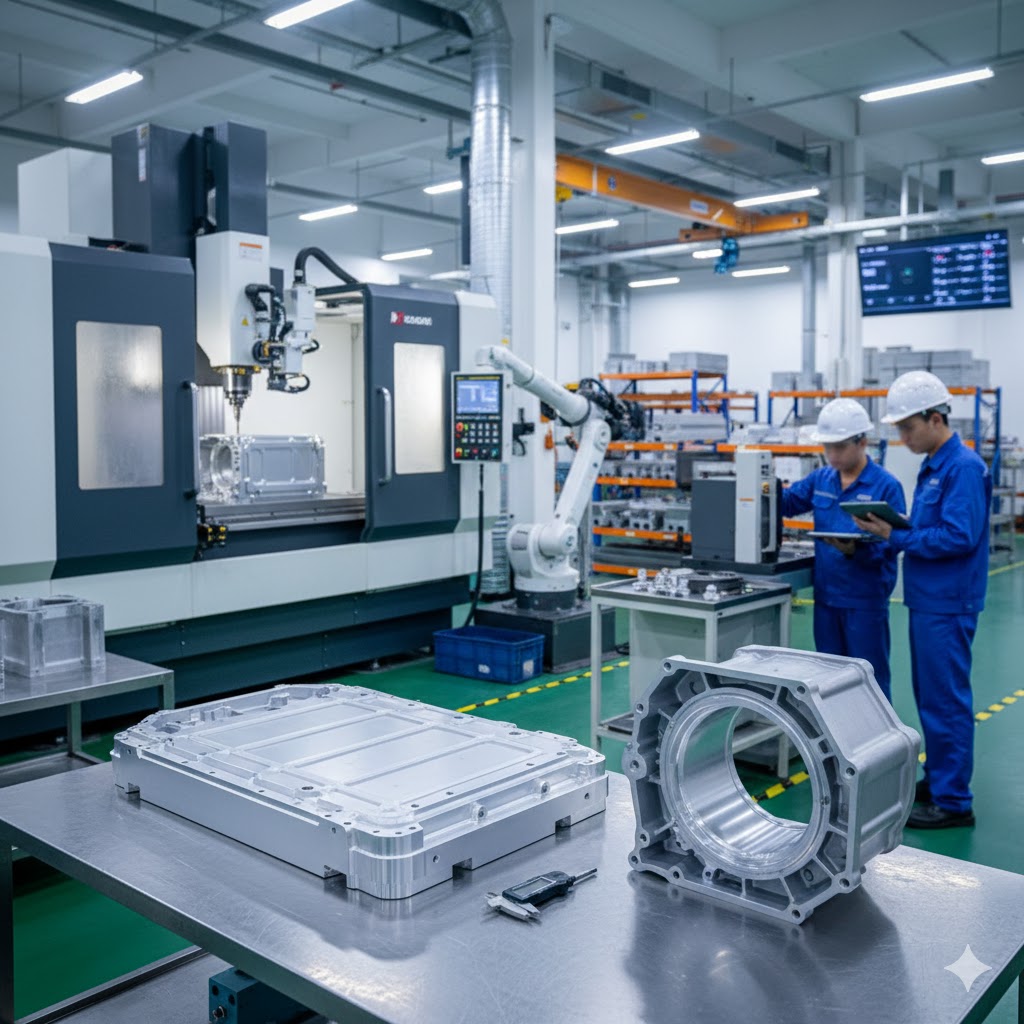
Modern EV Component Machining facilities operate 3-axis, 4-axis, and 5-axis CNC platforms capable of machining complex aluminum geometries. These systems support battery enclosure frames, cooling plates, inverter housings, and motor casings.
Because EV components require lightweight strength and thermal efficiency, aluminum alloys such as 6061 and 7075 are widely used. Precision machining ensures dimensional stability, especially in battery modules where tolerance deviations can affect assembly alignment.
Furthermore, advanced toolpath optimization and automated probing systems improve repeatability. High-speed spindles reduce cycle time while maintaining surface finish quality.
As EV adoption increases globally, Vietnam’s machining sector continues investing in high-precision CNC equipment to meet evolving technical standards.
Battery Housing CNC Production
Battery enclosures represent one of the most critical EV structural components. They protect lithium-ion cells, manage heat dissipation, and maintain structural rigidity under load.
Battery housing CNC
The capability for Battery housing CNC production includes multi-axis aluminum milling, high-flatness machining, and precision drilling for fastener integration. Because battery housings often span large dimensions, machining stability and fixture design are essential.
Additionally, cooling channel accuracy must be tightly controlled to ensure effective thermal management. Therefore, CNC centers integrate in-process probing and post-machining inspection to confirm dimensional conformity.
Surface finishing, including anodizing and protective coatings, is coordinated with certified partners to enhance corrosion resistance and electrical insulation performance.
Through structured production control, Vietnamese suppliers deliver export-ready battery housing solutions for international EV manufacturers.
Precision Motor Component Machining
Electric motors demand high-accuracy housings and support structures. Motor casings must align precisely with stator and rotor assemblies to prevent imbalance and vibration.
EV motor CNC machining
EV motor machining requires concentricity control, fine surface finishes, and stable wall thickness. Multi-axis CNC centers allow complex internal profiles to be machined without repositioning errors.
In addition, suppliers apply strict quality control protocols during motor housing production. Dimensional inspection via Coordinate Measuring Machines ensures alignment tolerances are met before shipment.
Because motor assemblies operate under high rotational speeds, machining accuracy directly influences performance reliability.
Electric Vehicle Parts Production Integration
Electric vehicle parts manufacturing extends beyond battery housings and motor casings. Structural brackets, inverter mounts, cooling plates, and lightweight frames are also commonly machined in Vietnam.
Production lines are designed to support mid-to-high volume output while maintaining dimensional repeatability. Automated loading systems and digital process monitoring enhance cycle consistency.
Moreover, EV machining suppliers frequently collaborate with design teams to improve manufacturability. By optimizing wall thickness and material selection, engineering teams reduce machining time and overall production cost.
This collaborative approach strengthens long-term partnerships with global EV OEMs.
Quality Systems for EV Component Machining
Export-focused EV machining facilities implement structured quality systems, including ISO 9001 and IATF 16949 standards. Although EV production does not require aerospace-level certification, strict dimensional control remains essential.
Inspection infrastructure commonly includes:
• Coordinate Measuring Machines
• Optical measurement systems
• Surface roughness testers
• Material verification equipment
In addition, digital documentation platforms track production batches, improving traceability and compliance transparency.
Through disciplined quality management, suppliers minimize defect rates and ensure consistent delivery performance.
Material Expertise and Thermal Management
Thermal management is critical in EV systems. Battery modules generate heat during operation, requiring effective cooling channel integration.
Machining aluminum components with optimized coolant flow and precision drilling improves heat transfer performance. Therefore, material knowledge and process control significantly influence component reliability.
Furthermore, advanced tooling coatings reduce friction and improve surface finish consistency. These technical refinements contribute to better overall product durability.
Supply Chain Readiness and Export Capability
Vietnam’s industrial zones are strategically located near major ports, improving export efficiency. Suppliers experienced in international trade documentation streamline customs procedures and shipping coordination.
Within the broader Transportation Machining Vietnam ecosystem, EV machining operations benefit from shared infrastructure and skilled labor pools.
However, buyers should conduct supplier audits to verify capacity alignment, equipment availability, and engineering expertise before finalizing contracts.
Cost Structure and Strategic Advantages
EV Component Machining in Vietnam offers competitive cost positioning compared to Western manufacturing hubs. Labor efficiency, combined with modern CNC platforms, creates a balanced cost-performance model.
Moreover, supply chain diversification reduces exposure to geopolitical concentration risk. Many international manufacturers integrate Vietnam into multi-country sourcing strategies to enhance resilience.
Although cost savings are attractive, technical reliability and quality control remain the primary selection criteria for EV components.
Sustainability and ESG Alignment
Electrification initiatives are closely tied to sustainability objectives. Therefore, EV machining suppliers invest in energy-efficient machinery, waste management systems, and environmentally compliant production practices.
Alignment with ESG standards enhances eligibility for global procurement programs and strengthens long-term competitiveness.
Engineering Collaboration and Project Support
Successful EV programs require close technical collaboration. Vietnamese machining providers offer manufacturability analysis, tolerance evaluation, and process planning during early project stages.
Structured communication channels improve development timelines and reduce production risk. As partnerships mature, suppliers often implement continuous improvement programs to optimize cycle time and cost efficiency.
Conclusion
EV Component Machining Vietnam represents a rapidly advancing segment within the country’s transportation manufacturing ecosystem. Through advanced battery housing CNC capability, precision motor machining, and structured quality systems, Vietnam delivers export-ready EV components aligned with global industry standards.
Supported by engineering expertise, scalable CNC infrastructure, and integration within Transportation Machining Vietnam, suppliers offer a reliable and commercially competitive solution for electric mobility production programs.