Aerospace Machining in Vietnam has advanced significantly in recent years, positioning the country as a reliable subcontracting destination for precision aerospace components. As global aerospace manufacturers diversify supply chains, Vietnam offers cost-effective CNC capabilities supported by structured quality systems and export-oriented production infrastructure.
Today, Aerospace Machining projects in Vietnam focus on tight tolerances, material traceability, and compliance with AS9100-aligned processes. While Vietnam is not yet a primary aircraft assembly hub, it increasingly serves as a high-precision secondary manufacturing base for aerospace contractors and Tier suppliers seeking controlled cost structures without compromising quality.
This service page outlines capabilities, certifications, inspection systems, and supply chain integration for aerospace CNC production in Vietnam.
Aerospace Machining Capabilities in Vietnam
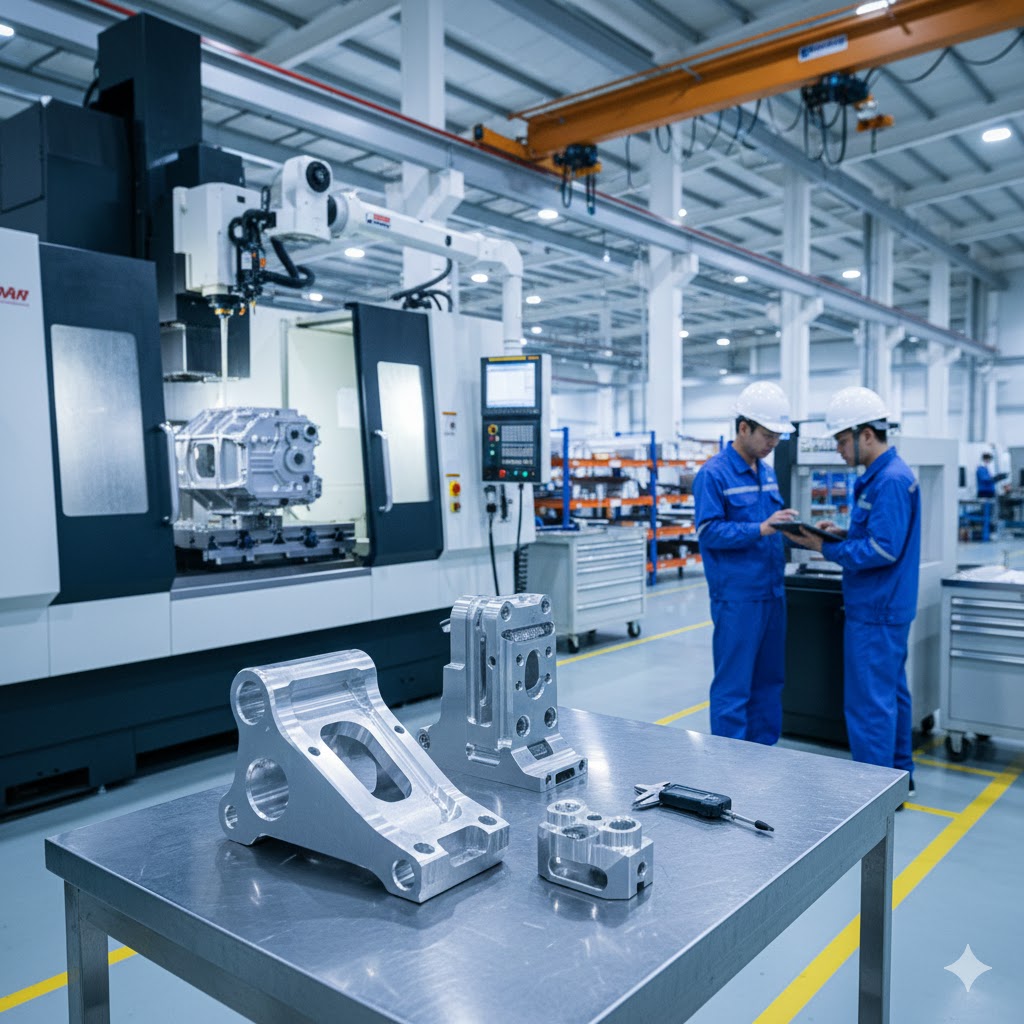
Modern Aerospace Machining facilities in Vietnam operate advanced 3-axis, 4-axis, and 5-axis CNC machining centers. These systems enable complex contouring, multi-surface machining, and precision drilling for structural and engine-related components.
Common aerospace components produced include:
• Structural aluminum brackets
• Titanium fittings and connectors
• Precision housings
• Mounting assemblies
• Lightweight support structures
Because aerospace programs require dimensional accuracy within microns, CNC machines are equipped with high-speed spindles, precision probing systems, and automated tool monitoring.
In addition, process optimization techniques such as high-speed machining and controlled chip evacuation improve surface finish quality while maintaining tolerance stability.
AS9100 Compliance and Quality Systems
Aerospace manufacturing demands structured quality management beyond conventional ISO standards. Therefore, suppliers involved in aerospace production must follow AS9100 principles or customer-specific aerospace compliance frameworks.
AS9100 machining
AS9100 machining ensures strict process documentation, risk management protocols, and traceability throughout the production lifecycle. This includes material certification tracking, lot control, and inspection record retention.
Moreover, suppliers implement:
• First Article Inspection (FAI)
• Statistical Process Control (SPC)
• Root cause analysis systems
• Controlled non-conformance handling
Through these measures, aerospace CNC operations reduce defect risk and enhance reliability across production batches.
Although not all facilities hold full AS9100 certification, many export-focused suppliers align their internal systems with aerospace compliance standards to meet international buyer requirements.
Precision CNC for Aircraft Components
Aerospace Machining often involves lightweight alloys and high-strength materials that require specialized tooling strategies.
Aircraft parts CNC
The capability for Aircraft parts CNC production includes aluminum milling, titanium machining, and stainless steel precision turning. These materials demand optimized cutting parameters to prevent thermal distortion and maintain structural integrity.
Furthermore, aircraft components frequently feature complex geometries. Multi-axis CNC machining reduces repositioning errors and improves repeatability.
Inspection plays a critical role. Coordinate measuring machines verify geometric tolerances, while surface roughness testers ensure finish requirements are achieved.
Because aircraft parts often integrate into safety-critical systems, strict validation procedures are applied before shipment.
Engineering Expertise and Process Control
Vietnam’s aerospace machining development is supported by a growing engineering workforce trained in mechanical and manufacturing disciplines.
Engineering teams collaborate with international buyers to interpret technical drawings, optimize tolerances, and improve manufacturability. This cooperative approach reduces cycle times and enhances cost efficiency.
In addition, digital workflow systems track each production stage. ERP integration supports batch control and documentation storage, improving transparency for global clients.
Inspection and Metrology Infrastructure
Reliable Aerospace Machining requires advanced inspection capability. Leading facilities integrate:
• Coordinate Measuring Machines (CMM)
• Optical inspection systems
• Hardness and material testing equipment
• Surface roughness analyzers
Inspection results are recorded digitally to ensure traceability. Furthermore, periodic calibration of equipment maintains measurement integrity.
By implementing structured inspection protocols, suppliers strengthen compliance and build long-term credibility.
Integration Within Transportation Manufacturing
Aerospace Machining Vietnam operates within the broader framework of Transportation Machining Vietnam, which includes EV and automotive sectors.
Cross-sector integration enables infrastructure sharing, capacity balancing, and continuous improvement initiatives. For example, high-precision CNC machines used for aerospace components may also support EV housing production when aligned with quality standards.
This flexibility enhances overall operational efficiency while maintaining compliance discipline for aerospace programs.
Material Expertise and Lightweight Engineering
Aerospace applications prioritize weight reduction and strength optimization. Consequently, aluminum alloys such as 6061 and 7075 are widely used. Titanium alloys are also common in high-performance assemblies.
Machining these materials requires controlled feed rates, specialized cutting tools, and coolant management systems. Therefore, technical knowledge in material behavior plays a decisive role in production quality.
Surface finishing processes such as anodizing and protective coatings are coordinated with certified partners to meet corrosion resistance requirements.
Supply Chain Readiness for Export
Vietnam’s export infrastructure supports aerospace machining logistics. Industrial zones located near major ports improve shipment efficiency and reduce transit times.
Additionally, suppliers experienced in international trade documentation streamline customs processes.
However, buyers should conduct supplier audits to verify certification status, engineering depth, and capacity alignment before committing to large production contracts.
Cost Efficiency and Risk Diversification
Aerospace Machining in Vietnam provides competitive cost structures compared to Western markets. Labor rates remain attractive, while machining technology continues to advance.
Beyond cost savings, supply chain diversification reduces geopolitical concentration risk. Many aerospace companies integrate Vietnam as part of a multi-country sourcing strategy.
Although pricing advantages are relevant, technical reliability remains the primary selection criterion in aerospace manufacturing.
Sustainability and ESG Considerations
Global aerospace procurement increasingly emphasizes ESG compliance. Therefore, Vietnamese suppliers invest in wastewater treatment systems, energy-efficient machinery, and waste reduction initiatives.
Alignment with environmental standards strengthens competitiveness in international bidding processes.
Project Collaboration and Customer Support
Export-oriented aerospace machining providers offer technical consultation during project initiation. This includes tolerance analysis, manufacturability reviews, and production planning.
Transparent communication reduces development risk and accelerates production ramp-up.
Long-term partnerships benefit from structured quality reviews and continuous improvement programs.
Conclusion
Aerospace Machining Vietnam represents a growing segment within the country’s precision manufacturing ecosystem. With AS9100-aligned systems, advanced CNC capability, and expanding inspection infrastructure, Vietnam supports subcontracting programs for aircraft structural and precision components.
Through investment in technology, engineering expertise, and compliance frameworks, Aerospace Machining providers in Vietnam offer a balanced combination of cost efficiency and export-grade quality.
For aerospace OEMs and Tier suppliers seeking diversified sourcing options, Vietnam provides a technically viable and commercially competitive solution within the broader transportation manufacturing landscape.