
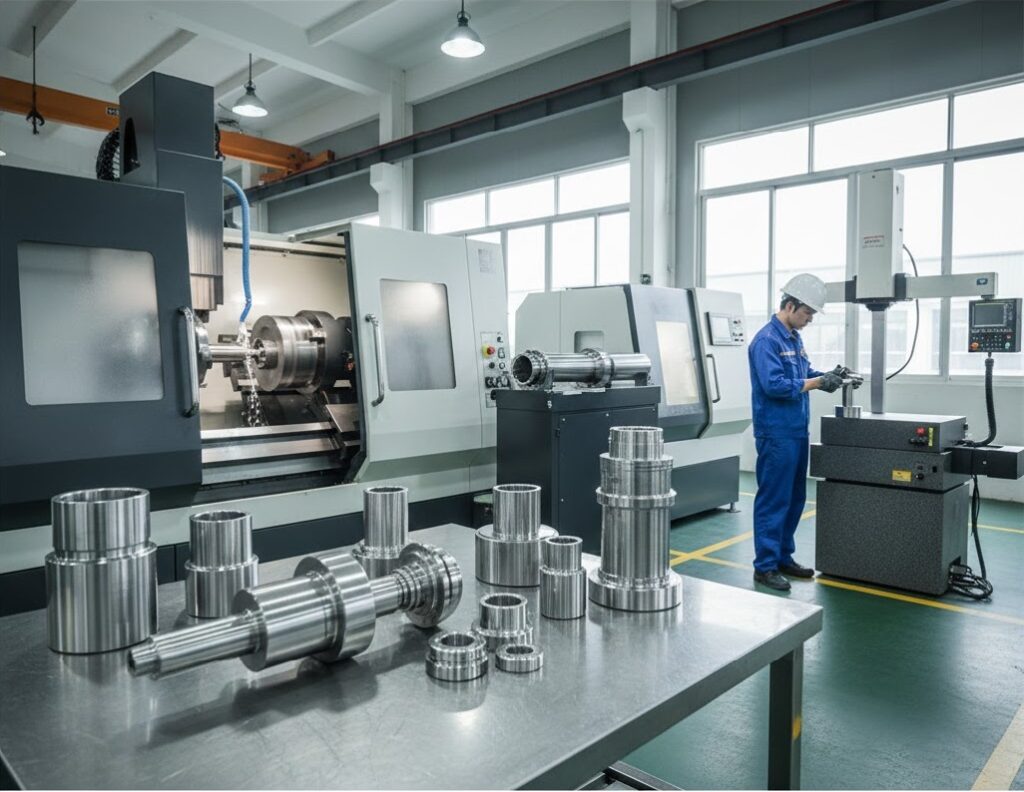
CNC Turning Vietnam has become a strategic solution for international manufacturers seeking high-precision cylindrical components with consistent quality and competitive cost. As global buyers diversify their supply chains, Vietnam’s advanced turning capabilities now support automotive, industrial equipment, electronics, and energy sectors.
CNC Turning Vietnam focuses on producing rotational parts such as shafts, bushings, fittings, connectors, and threaded components. By combining modern CNC lathes with strict quality control systems, Vietnamese manufacturers deliver tight tolerances and reliable repeatability. Consequently, procurement teams at the decision stage increasingly consider Vietnam a dependable machining partner.
Why CNC Turning Vietnam Delivers Competitive Advantage
CNC Turning Vietnam provides technical efficiency and cost effectiveness within a stable manufacturing ecosystem. Modern CNC lathes equipped with high-speed spindles and automatic bar feeders ensure consistent cycle times and smooth surface finishes.
Precision turning is essential when concentricity and dimensional alignment directly impact product performance. For example, hydraulic shafts, transmission components, and motor assemblies require strict tolerance control to avoid vibration and premature wear. Vietnamese machining facilities address these requirements through optimized tooling strategies and real-time monitoring systems.
Moreover, reduced labor cost compared to Western markets enhances price competitiveness without compromising technical quality. Combined with export-ready infrastructure, this advantage strengthens Vietnam’s position as a reliable turning hub.
Advanced CNC Lathe Technology and Capabilities
Modern CNC turning centers in Vietnam feature multi-axis functionality and live tooling systems. These machines allow secondary milling, drilling, and tapping operations within the same setup. As a result, production efficiency improves while geometric accuracy remains stable.
High-speed CNC lathes can handle a wide range of materials including aluminum, stainless steel, carbon steel, brass, and engineering plastics. Toolpath programming through advanced CAM software ensures optimal feed rates and minimal tool wear.
In addition, automated loading systems support medium to high-volume production runs. This automation reduces manual handling errors and improves consistency across batches.
Because global clients require traceability, many factories operate under ISO 9001 quality systems. Inspection reports and dimensional measurement data are routinely provided with shipments.
CNC Turning Vietnam for Tight Tolerances
Dimensional Accuracy and Concentricity
CNC Turning Vietnam facilities typically achieve tolerances of ±0.01 mm depending on material and part complexity. High-precision chucks and stable fixturing systems ensure concentric alignment during machining.
Coordinate measuring machines validate key dimensions before parts proceed to final packaging. This systematic inspection reduces non-conformance risks.
Surface Finish and Thread Precision
Surface finish quality plays a critical role in mechanical performance. Proper tool selection and coolant management produce smooth finishes that reduce friction and wear.
Threading operations require precise pitch and depth control. CNC lathes execute these operations automatically with repeatable accuracy, ensuring reliable assembly in downstream applications.
Industries Served by CNC Turning Vietnam
Vietnamese turning services support a wide range of industrial sectors.
Automotive manufacturers source drive shafts, bushings, and brake components.
Industrial equipment producers require valve bodies and mechanical connectors.
Electronics companies depend on precision housings and cylindrical connectors.
Energy and fluid control systems rely on machined fittings and couplings.
Each sector demands consistent dimensional control and material reliability. CNC Turning Vietnam addresses these requirements through structured process management.
Furthermore, flexible production capacity supports both prototype development and scaled manufacturing. Buyers can validate design concepts before committing to full production.
Quality Control and Inspection Process
Quality assurance in CNC Turning Vietnam follows a multi-stage approach.
Incoming material inspection verifies chemical composition and mechanical properties.
In-process checks confirm dimensional accuracy at critical points.
Final inspection ensures compliance with drawing specifications.
Statistical process control helps detect trends before deviations affect large production batches. This preventive approach reduces scrap rates and improves overall efficiency.
Additionally, export packaging standards protect machined surfaces during international transport. Protective coatings and vacuum sealing minimize corrosion risks.
Production Efficiency and Lead Time
CNC Turning Vietnam optimizes lead time through integrated manufacturing workflows. Because live tooling reduces secondary operations, overall cycle time decreases significantly.
Standard lead time typically ranges from two to five weeks depending on volume and material availability. Prototyping cycles can be shorter when engineering files are clearly defined.
Transparent communication and digital scheduling systems provide buyers with real-time updates. Consequently, procurement teams gain predictable delivery timelines.
As global markets demand agility, efficient lead time management becomes a critical competitive factor.
Material Expertise and Finishing Services
Vietnamese turning facilities process various materials tailored to industry needs.
Aluminum alloys support lightweight applications.
Stainless steel provides corrosion resistance.
Carbon steel ensures structural strength.
Brass and copper offer electrical conductivity advantages.
Secondary finishing services such as anodizing, plating, polishing, and grinding are often integrated within the same manufacturing network. This consolidation reduces supply chain fragmentation and improves coordination.
Moreover, design for manufacturability consultation helps optimize part geometry before production. Early collaboration prevents unnecessary machining complexity.
CNC Milling Vietnam Integration
CNC Milling Vietnam complements turning operations by handling prismatic and multi-surface components. Many manufacturers integrate milling and turning within a single facility.
This combination supports complex assemblies that require both cylindrical and non-cylindrical features. By consolidating processes under one supplier, buyers simplify project management and strengthen quality accountability.
Integrated machining strategies reduce handling time and improve dimensional alignment between related components.
Precision Lathe Work Expertise
Precision lathe work defines the core strength of Vietnamese turning services. Skilled machinists and advanced CNC programming ensure repeatable accuracy even for intricate geometries.
This expertise supports industries where rotational symmetry and surface finish directly influence functional performance. Tight tolerance shafts and threaded connectors benefit from consistent lathe precision.
High-speed spindles and stable fixturing systems enhance concentricity control and minimize vibration during cutting.
CNC Lathe Vietnam Capabilities
CNC lathe Vietnam facilities operate modern turning centers capable of both small-batch customization and large production volumes. Automatic bar feeders and robotic handling systems improve throughput efficiency.
Because decision-stage buyers prioritize reliability, these facilities implement structured documentation and inspection reporting. Such transparency supports long-term partnerships with international clients.
Advanced CNC lathes also integrate live tooling, allowing secondary machining without transferring parts between machines. This reduces tolerance stack-up and shortens overall production cycles.
Strategic Considerations for Decision-Stage Buyers
Selecting a CNC turning partner requires evaluating both technical and operational criteria. Machine capability alone does not guarantee performance. Engineering support, quality systems, and communication responsiveness are equally important.
Clear technical drawings and tolerance specifications accelerate quotation accuracy. Pilot production runs validate machining strategies before scaling to full volume.
Long-term collaboration thrives on transparency and documented process control. Therefore, procurement teams should prioritize suppliers with proven export experience and structured quality management.
Vietnam’s stable manufacturing environment, competitive cost structure, and growing technical expertise position it as a strong partner for precision turning projects.
Conclusion
CNC Turning Vietnam delivers high-precision cylindrical components for global industries seeking reliable and cost-effective manufacturing solutions. Through advanced CNC lathe technology, strict quality control, and integrated machining capabilities, Vietnamese suppliers meet demanding international standards.
By combining technical competence with export-ready infrastructure, Vietnam strengthens its role as a strategic turning hub in Southeast Asia. For companies at the decision stage, partnering with a capable CNC turning provider in Vietnam ensures both performance reliability and long-term operational value.