Multi-Axis CNC Vietnam has become a critical solution for global manufacturers that require complex geometries, tight tolerances, and consistent production quality. As industrial supply chains shift toward Southeast Asia, Vietnam’s advanced multi-axis machining capabilities now support high-performance components across automotive, aerospace support, electronics, and heavy machinery sectors.
Unlike conventional machining setups, multi-axis systems allow simultaneous movement across multiple planes. This capability reduces setups, increases dimensional stability, and enhances surface finish quality. Consequently, international buyers seeking precision and efficiency increasingly turn to Vietnam for advanced milling solutions.
Why Multi-Axis CNC Vietnam Delivers Higher Precision
Multi-Axis CNC Vietnam offers significant technical advantages compared to traditional 3-axis systems. While 3-axis machines operate along X, Y, and Z directions, 4-axis and 5-axis systems introduce rotational movement. As a result, complex contours and undercuts can be machined in a single setup.
Reduced repositioning directly improves accuracy. Each time a workpiece is re-clamped, there is potential for deviation. Multi-axis machining minimizes this risk. Therefore, dimensional consistency improves across production batches.
Additionally, surface finish quality benefits from continuous tool engagement. Smooth transitions between surfaces reduce manual polishing requirements. This leads to shorter production cycles and lower secondary processing costs.
Furthermore, cycle time optimization enhances productivity. Simultaneous axis movement allows faster material removal while maintaining structural integrity. Consequently, buyers achieve both precision and efficiency.
Advanced Equipment and Technical Capabilities
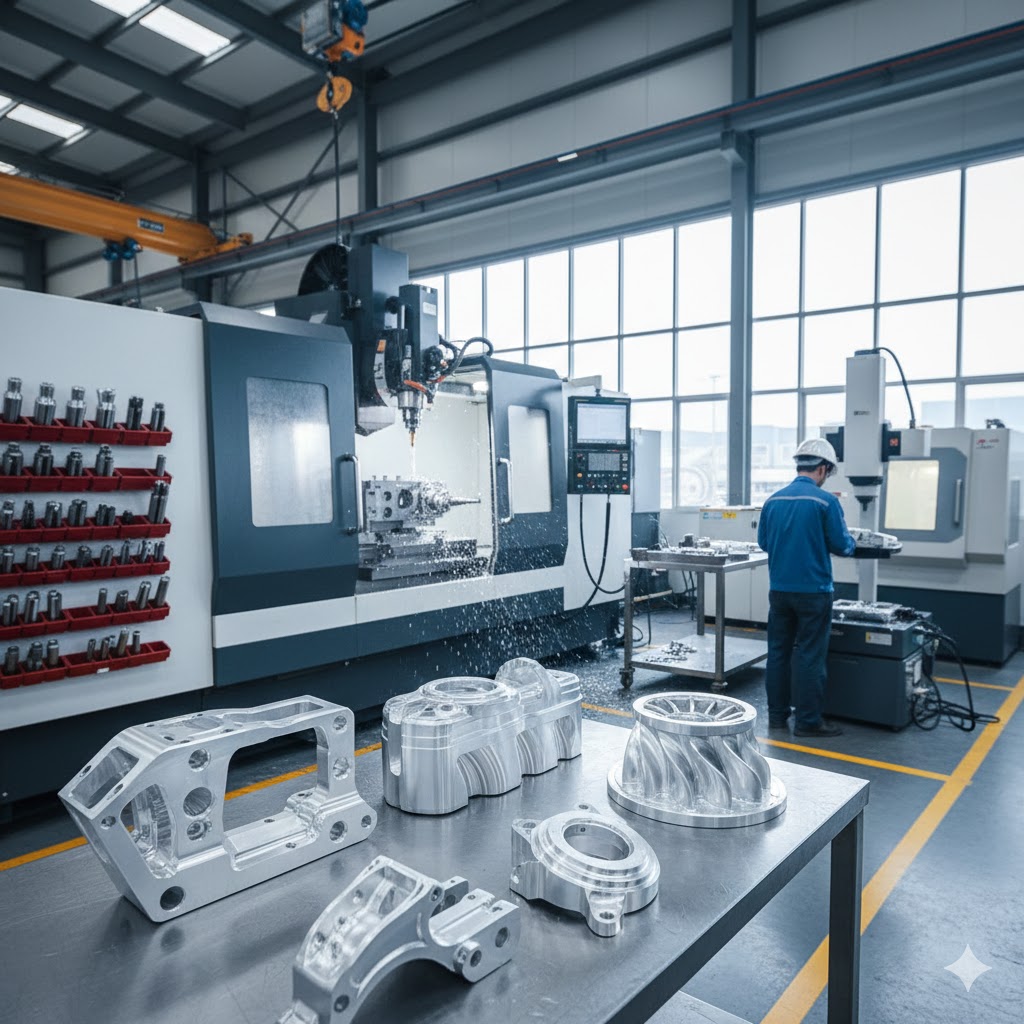
Modern Vietnamese machining facilities invest heavily in 4-axis and 5-axis machining centers sourced from Japan, Germany, and South Korea. These machines are equipped with high-speed spindles, automatic tool changers, and advanced coolant systems.
High-performance CAM software optimizes toolpaths before production begins. Engineers simulate machining sequences to avoid collisions and minimize tool wear. This proactive approach reduces scrap rates and enhances reliability.
Climate-controlled workshops further support tight tolerance production. Temperature stability prevents thermal expansion that could affect micron-level accuracy. In addition, coordinate measuring machines validate critical dimensions before shipment.
Because export markets demand repeatability, factories implement documented quality systems. Inspection reports, material certificates, and process control documentation are standard deliverables for international customers.
Applications Across Industrial Sectors
Multi-Axis CNC Vietnam supports industries where geometry complexity and tolerance control are non-negotiable.
Automotive suppliers require intricate engine components, transmission housings, and structural brackets.
Aerospace support manufacturers demand lightweight aluminum structures with high dimensional precision.
Electronics producers depend on precision heat sinks and enclosures with complex internal channels.
Industrial equipment manufacturers source mold components and heavy-duty mechanical assemblies.
These sectors benefit from multi-surface machining that eliminates the need for multiple production stages. As a result, time-to-market improves significantly.
Moreover, flexible batch production enables both prototyping and mid-volume manufacturing. Buyers can test design iterations without committing to large tooling investments.
Multi-Axis CNC Vietnam vs 3-Axis Milling
Understanding the difference between multi-axis and 3-axis systems is essential when selecting a machining partner.
3-axis milling remains effective for flat surfaces and simple prismatic parts. It offers cost efficiency for straightforward geometries. However, complex shapes often require multiple setups under this configuration.
Multi-axis systems, in contrast, machine multiple faces simultaneously. This reduces manual repositioning and ensures geometric alignment. Therefore, tolerance stack-up errors decrease significantly.
For example, turbine components or mold cavities benefit greatly from 5-axis capability. Intricate curves and deep pockets can be produced without additional fixturing.
Although multi-axis equipment requires higher capital investment, the long-term efficiency gains often outweigh the initial cost difference.
Quality Assurance and Tolerance Control
Precision is the defining metric for Multi-Axis CNC Vietnam services. Typical tolerance levels reach ±0.01 mm, and even tighter specifications are achievable depending on material and geometry.
Incoming material inspection verifies mechanical properties and composition. In-process measurement ensures dimensional accuracy at critical stages. Final inspection confirms compliance before packaging.
Statistical process control techniques further enhance reliability. By monitoring variation trends, engineers can correct deviations before they affect output quality.
Surface roughness measurements and geometric dimensioning validation support compliance with international standards. As a result, buyers gain confidence in long-term production consistency.
Material Expertise and Surface Finishing
Vietnamese machining facilities process a wide range of materials including aluminum alloys, stainless steel, tool steel, brass, copper, and engineering plastics.
Aluminum remains particularly popular due to its machinability and lightweight characteristics. Multi-axis systems maximize its performance in aerospace and automotive components.
Surface finishing services such as anodizing, powder coating, and precision grinding are often integrated within the same manufacturing ecosystem. This reduces subcontracting risks and simplifies project management.
Moreover, consolidated production workflows shorten lead times while maintaining strict quality control.
Production Efficiency and Lead Time
Multi-Axis CNC Vietnam enhances production efficiency through reduced setups and optimized toolpaths. Because fewer manual interventions are required, cycle time decreases significantly.
Lead time typically ranges from three to five weeks depending on complexity and volume. Prototype development may be completed faster when engineering files are clearly defined.
Transparent scheduling systems provide real-time updates on project status. Buyers benefit from improved visibility and predictable delivery timelines.
As global supply chains become more dynamic, reliable lead time management remains a competitive advantage.
CNC Milling Vietnam Service Integration
CNC Milling Vietnam represents the broader machining ecosystem that integrates multi-axis capability with traditional milling and turning processes. Within this framework, suppliers offer drilling, tapping, surface finishing, and assembly support.
This integration reduces supplier fragmentation. Instead of coordinating multiple vendors, buyers can consolidate sourcing under one technical partner. Consequently, communication improves and quality accountability strengthens.
CNC Milling Services for Industrial Buyers
CNC milling services in Vietnam extend beyond simple cutting operations. Providers offer design for manufacturability consultation, material selection guidance, and process optimization.
Engineering collaboration early in the project lifecycle reduces production risk. Modifications at the design stage often improve cost efficiency and structural performance.
By aligning technical requirements with machining strategy, suppliers ensure scalable production capability for long-term contracts.
3-Axis Milling Capabilities
3-axis milling remains relevant for simpler geometries and cost-sensitive projects. Many manufacturers combine 3-axis systems with multi-axis equipment to optimize production cost.
Flat plates, brackets, and basic mechanical components often utilize this method effectively. Because machine setup is straightforward, turnaround time for simple parts can be extremely competitive.
This hybrid capability allows suppliers to match machining technology to project complexity rather than over-engineering the solution.
Strategic Considerations for Decision-Stage Buyers
At the decision stage, buyers should evaluate more than machine count. Engineering expertise, quality systems, and communication responsiveness are equally critical.
Clear technical documentation accelerates quotation accuracy. Meanwhile, pilot production runs help validate machining strategies before scaling up.
Long-term collaboration thrives on transparency. Defined lead times, documented inspection protocols, and structured pricing models create a foundation for sustainable partnership.
Moreover, as global procurement teams prioritize risk diversification, Vietnam’s stable manufacturing environment strengthens supply chain resilience.
Conclusion
Multi-Axis CNC Vietnam has evolved into a high-performance machining solution capable of meeting demanding international standards. Through advanced 4-axis and 5-axis systems, Vietnamese manufacturers produce complex components with precision, efficiency, and consistency.
By combining technical capability, competitive cost structure, and integrated quality systems, Vietnam positions itself as a strategic machining hub for global industries. For companies seeking reliable multi-axis milling solutions, partnering with an experienced Vietnamese supplier delivers both operational excellence and long-term value.