CNC Milling Vietnam has become a strategic solution for global manufacturers seeking precision, cost efficiency, and supply chain diversification. As industrial buyers evaluate machining partners in Southeast Asia, Vietnam stands out for its technical capability, stable workforce, and competitive production costs. In particular, the combination of advanced milling and turning technologies enables suppliers to deliver complex components with tight tolerances for demanding industries.
Today, buyers in automotive, industrial equipment, aerospace support industries, and electronics require machining partners who can handle both multi-surface milling operations and high-precision turning processes. Therefore, selecting a capable CNC partner in Vietnam is no longer simply a cost decision. It is a long-term strategic choice that affects quality, lead time, and scalability.
Why CNC Milling Vietnam Is Gaining Global Attention
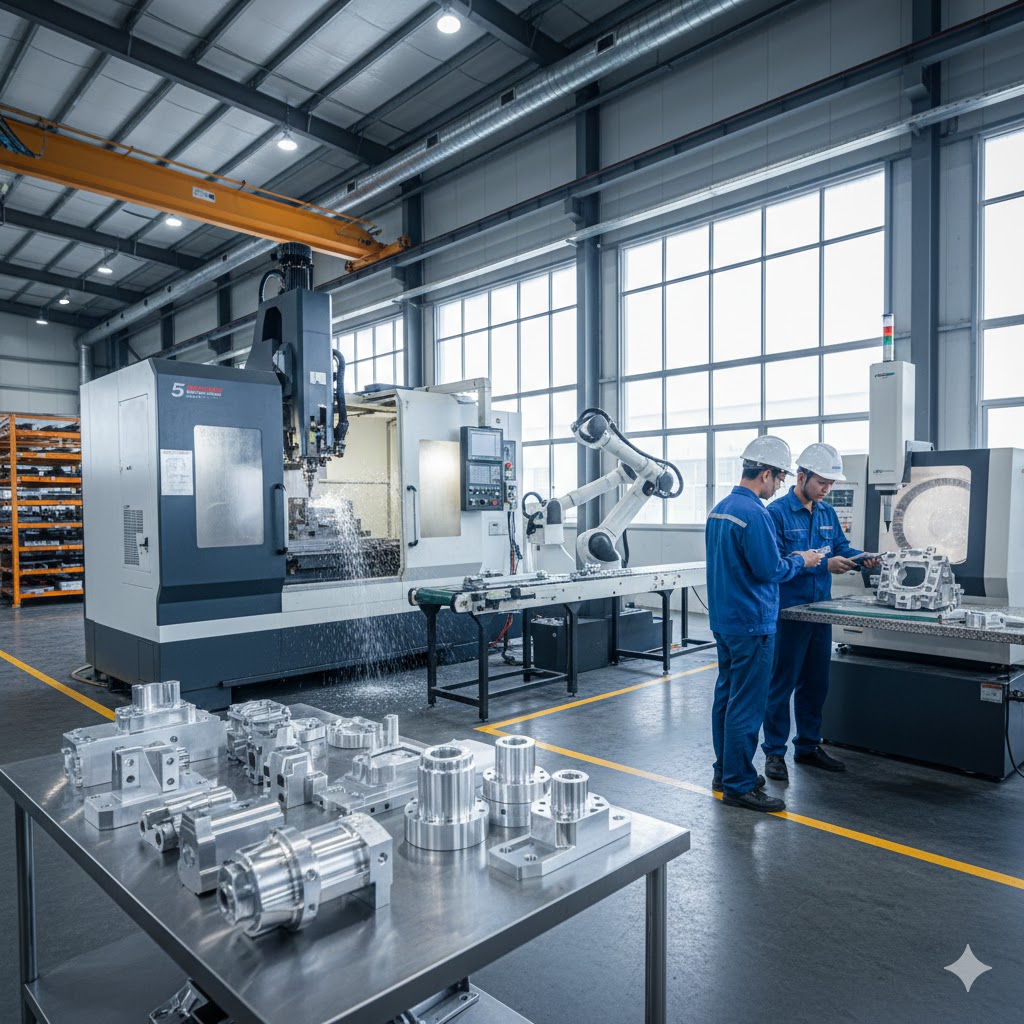
CNC Milling Vietnam has evolved rapidly over the past decade. Initially focused on basic subcontracting work, many Vietnamese manufacturers have now invested in advanced 3-axis, 4-axis, and 5-axis machining centers. As a result, factories can produce complex geometries, deep cavities, contoured surfaces, and precision features in a single setup.
Several structural advantages explain this growth:
First, Vietnam benefits from a strong manufacturing ecosystem. Tooling suppliers, material distributors, and surface treatment partners are readily available. Consequently, lead times are shorter compared to fragmented sourcing models.
Second, labor costs remain competitive while technical skills continue to improve. Many machinists and engineers receive formal training in CAD/CAM programming and process optimization. This ensures repeatable accuracy and process stability.
Third, export-oriented factories operate under international quality standards such as ISO 9001. Some suppliers also meet automotive and aerospace compliance requirements. Therefore, global buyers can expect traceability and documented quality control procedures.
Moreover, geopolitical shifts have encouraged companies to diversify away from single-country sourcing strategies. In this context, Vietnam offers a stable and business-friendly environment for long-term collaboration.
Integrated Milling and Turning Capabilities
While CNC Milling Vietnam focuses on prismatic parts and complex geometries, turning operations are equally critical for cylindrical components. Shafts, bushings, threaded connectors, and rotating parts require precision lathe work to ensure concentricity and surface finish.
Modern Vietnamese machining centers increasingly integrate milling and turning in one production line. This hybrid approach provides several advantages:
Reduced setup time improves production efficiency.
Fewer transfers between machines minimize dimensional variation.
Cycle times are optimized through synchronized programming.
Furthermore, advanced CNC lathes equipped with live tooling allow simultaneous milling operations during turning cycles. This reduces handling time and enhances overall productivity.
By combining both processes, suppliers can manufacture components such as gearbox housings, pump bodies, hydraulic fittings, and motor assemblies with high dimensional accuracy.
Quality Control and Precision Standards
Precision is the core requirement in any CNC environment. In CNC Milling Vietnam facilities, quality assurance is typically structured around three stages.
Incoming material inspection verifies chemical composition and mechanical properties.
In-process inspection monitors critical dimensions using digital calipers, micrometers, and coordinate measuring machines (CMM).
Final inspection validates tolerances, surface finish, and functional requirements before shipment.
Tolerance levels often reach ±0.01 mm or tighter, depending on part complexity. For high-spec applications, statistical process control is implemented to maintain consistency across batches.
Additionally, many factories use CAD/CAM simulation software to prevent tool collisions and optimize machining strategies before production begins. This proactive approach reduces scrap rates and ensures predictable outcomes.
Because export markets demand reliability, packaging and logistics are also standardized. Protective coatings, vacuum sealing, and shock-resistant packaging help preserve part integrity during international shipping.
Cost Structure and Lead Time Considerations
Cost efficiency remains a major driver for outsourcing machining operations. However, buyers must evaluate total landed cost rather than unit price alone.
CNC Milling Vietnam offers advantages in several cost components:
Lower labor costs compared to China and Western markets.
Competitive electricity and facility expenses.
Government incentives for export manufacturing.
At the same time, Vietnam’s improving infrastructure reduces transit delays. Ports such as Hai Phong and Ho Chi Minh City handle large export volumes efficiently.
Lead time typically ranges from two to six weeks depending on part complexity and material availability. Prototyping cycles can be shorter when CAD files and technical drawings are clearly defined.
Therefore, strategic planning and early engineering collaboration significantly improve time-to-market performance.
Applications Across Industrial Sectors
CNC Milling Vietnam supports a wide range of industries.
Automotive manufacturers rely on precision brackets, housings, and drivetrain components.
Industrial machinery producers require structural frames, mounting plates, and mechanical assemblies.
Electronics companies depend on aluminum heat sinks and precision enclosures.
Energy equipment suppliers source turbine components and valve bodies.
Because machining processes are highly adaptable, suppliers can shift between aluminum, stainless steel, brass, and engineering plastics with minimal reconfiguration.
Furthermore, many Vietnamese machining hubs operate flexible production cells. This allows small-batch customization as well as medium-volume manufacturing.
Digitalization and Process Optimization
Modern CNC environments integrate digital tools to enhance efficiency. Production scheduling software coordinates machine utilization and workforce allocation. Meanwhile, ERP systems track material flow and production status in real time.
Advanced toolpath optimization reduces machining time while maintaining surface integrity. In addition, predictive maintenance systems help prevent unexpected downtime.
As digital adoption expands, CNC Milling Vietnam suppliers increasingly align with Industry 4.0 principles. Consequently, global buyers gain better transparency and process control.
CNC Machining Vietnam Ecosystem
CNC Machining Vietnam represents the broader manufacturing framework that supports milling and turning operations. Within this ecosystem, suppliers offer complementary services such as drilling, tapping, surface grinding, anodizing, and powder coating.
This integrated model reduces reliance on multiple subcontractors. Instead, buyers can consolidate sourcing under one technical partner. As a result, communication becomes more streamlined, and quality accountability improves.
Moreover, centralized project management ensures that design modifications are implemented consistently across production stages.
Multi-Axis CNC Vietnam Capabilities
Multi-Axis CNC Vietnam solutions enable manufacturers to produce intricate geometries that would otherwise require multiple setups. Five-axis machining centers rotate and tilt parts simultaneously, allowing complex contours and undercuts to be machined in a single cycle.
This technology is particularly valuable for aerospace components, mold inserts, and high-precision tooling. Because repositioning is minimized, dimensional consistency improves significantly.
Additionally, cycle time reduction enhances production efficiency, which ultimately lowers overall manufacturing costs for complex parts.
CNC Turning Vietnam Expertise
CNC Turning Vietnam operations specialize in cylindrical components and rotational symmetry parts. High-speed lathes equipped with automatic bar feeders support continuous production runs.
Precision turning ensures tight concentricity, smooth surface finishes, and accurate thread profiles. These characteristics are essential for hydraulic systems, automotive shafts, and mechanical couplings.
When integrated with milling functions, turning centers expand their capability to handle cross-drilling, slotting, and contouring without transferring the workpiece.
High Precision CNC for Tight Tolerances
High Precision CNC solutions address applications where tolerance control is critical. Industries such as medical devices, precision instruments, and advanced electronics require near-micron accuracy.
In these environments, climate-controlled workshops stabilize thermal expansion. Specialized cutting tools and optimized feed rates maintain surface integrity.
Inspection equipment such as CMM and optical measurement systems verifies compliance with strict dimensional requirements. Consequently, high-precision machining builds confidence for mission-critical components.
Strategic Considerations for International Buyers
Selecting a CNC partner involves more than technical capability. Buyers should evaluate communication responsiveness, engineering support, and quality documentation practices.
Clear RFQ documentation, including 3D models and tolerance specifications, accelerates quotation accuracy. Meanwhile, early engagement with engineering teams allows manufacturability improvements before production begins.
Long-term collaboration also benefits from transparent pricing structures and clearly defined lead times. When expectations are aligned, partnerships become sustainable and scalable.
Conclusion
CNC Milling Vietnam has matured into a reliable and competitive solution for global manufacturers. By combining advanced milling technologies with precision turning capabilities, Vietnamese suppliers deliver high-quality components across multiple industries.
Furthermore, strong quality control systems, digital integration, and cost advantages position Vietnam as a strategic manufacturing hub. For companies seeking dependable machining services with global export readiness, Vietnam offers both technical depth and commercial viability.
As supply chains continue to evolve, partnering with a capable CNC provider in Vietnam can strengthen resilience, improve cost efficiency, and support long-term growth objectives.